The Long-term, Real Return on Stocks is only 4-5%

Caltech Professor Bradford Cornell has written a great paper published in the Financial Analysts Journal called "Economic Growth and Equity Investing". He has performed a detailed, eloquent analysis that backs up my stock market valuation model (described here, updated many times here, and most recently conducted here).  He posits that long-term, real earnings and dividend growth is unlikely to exceed 2% (I use 1.7% for the S&P 500 based on the historical trend).  When combined with the dividend yield you are looking at a total real return of 4-5%.

Professor Cornell's paper is here: Download Economic Growth and Equity Investing I warn you, it is "wonky".

So if trend earnings growth is fixed, and the dividend yield is known at any given time, the variable in valuing the market is the assumption for future inflation.  (Projected Return = dividend yield + real trend earnings growth rate + long term inflation rate.)  Provided the long term inflation assumption is moderate, and thus interest rates are reasonably low, inflation and equity prices are positively correlated.  I explain here how sensitive the market multiple is to changes in inflation expectations.

The key to beating the market short term is determining whether the market assumption for long-term inflation expectations is too low or too high.  The rise in inflation expectations from 1.3% in March to 2.7% in January can explain virtually all of the rise in the stock market in that time.

I believe that investors should err on the side of assuming inflation will be lower than normal.  I know this conflicts with what alot of people believe given our aggressive monetary and fiscal stimulus.  The problem is, that monetary and fiscal stimulus is just offsetting aggressive deleveraging in the private market, particularly among consumers and banks.  Private deleveraging will continue until the housing market stabilizes and the banking system's leverage stabilizes.  The banking system will not stabilize until after it has digested the proposed financial system reforms.  Since the United States can not simply devalue its currency the way that smaller countries can, it can only deleverage via a period of belt-tightening.  Deleveraging and belt-tightening mean struggling with deflation.

In my previous article "These are not Unprecedented Times" I discuss the long wave pattern called the Kondratiev Cycle.  Google that term and you can learn all about it.  While I don't think it can be used as a market-timing system and I realize that each cycle is different, the pattern it describes provides a good framework for understanding what is going on.  Most economists have been building models with data that goes back to World War II and have left out a key part of the long cycle: the Kondratiev Winter.  When the Autumn-season leverage-driven asset inflation has run its course, a long period of debt and asset deflation sets in.  While stimulus may offset actual deflation, it will be difficult for inflation to be above average if the banking system is deleveraging and without a large currency devaluation.  I'm not saying it's impossible.  It's just highly unlikely.

The current market assumption for long-term inflation is 2.6%.  That is slightly above the Fed's implied target of 2.0% to 2.5%.  This with Federal deficits of 10+%, the Fed Funds rate of 0% and a large bout of "quantitative easing".  The foot can not be on the stimulus pedal much harder than it is.

I don't make short-term market calls.  Clearly, the stock market could continue to rise for a whole host of reasons.  The next recession, whenever it comes, will likely be deflationary (no more bullets are in the stimulus gun) and the stock market will be hammered anew.  Investors beware.

Q3 Market Update – A low return world

In the third quarter of 2009, we have seen some pretty significant market shifts relative to the second quarter. To refresh yourself on how my market valuation model works, please refer to this page.

Inflation and the Treasury Yield Curve

As I outlined in my May 25th post "Inflation is not a threat (yet)", I look at the treasury curve, the dollar and gold to take the market's pulse on inflation.

The TIPS spread, which is the difference between the nominal yield on bonds less the yield on the Treasury Inflation Protected Security (TIPS) has seen some interesting shifts. While the 10-year inflation rate has remained right around 1.7%, the 5-year inflation rate rose from 0.8% on May 25 to 1.7% at the end of Q2, to 2.2% at the end of Q3. The 30-year inflation rate, on the other hand, has fallen from 2.2% on May 25 to 2.0% at the end of Q3.

Embedded in these numbers is the assumption that inflation surges from zero today to average 2.2% per year over the next 5 years. Inflation is then expected to slow to 1.3% per year from 2015 to 2019, before averaging 2.1% per year for the 20 years after that. This scenario is plausible. It implies a surge in economic activity after all the stimulus currently in the pipeline, before re-succumbing to the disinflationary undertow as the economic cycle turns down several years from now.

My other near-term inflation signals are also flashing yellow. Gold has traded to slightly higher than $1000 per ounce, and the dollar is very close to the bottom of its long term trading range. They aren't yet past the point where I'll start screaming that the Fed needs to hit the brakes, but they are right at the edge.

What does a flattening of the real yield curve mean?

In my May 25th post I discussed how the proper rate for overnight money is around 2.75% if inflation is averaging 2% per year. This would deliver a zero percent after-tax, after inflation rate of return, which is what you should earn for taking no risk. That would imply an equilibrium overnight TIPS spread of 0.75%. In my equilibrium model, I have assumed an upward-sloping real yield curve of 1% for the 2-year, 1.5% for the 5-year, 2% for the 10-year and 2.5% for the 30-year. The current TIPS real yield curve is 0.5% below my "equilibrium" along the curve from the 5-year on. The difference between the 0.75% overnight real yield and the higher yields further out is driven by uncertainty regarding future inflation volatility, which increases as the time horizon gets longer. If the TIPS curve has flattened, that implies that future inflation volatility assumptions have come down.

Much of the flattening move came in the last week after Fed Governor Kevin Warsh wrote an Opinion piece in the Wall Street Journal declaring that the Fed would be vigilant about removing stimulus if inflation became a threat. In other words, they wouldn't make the mistake they made earlier this decade, when they let inflation run and were too slow to remove monetary accommodation. If a flatter TIPS curve becomes a permanent feature of the financial markets, then asset yields would come down permanently and asset values would rise permanently.

What happens to my market equilibrium assumptions?

(As a reminder, I use the yield of various Vanguard bond mutual funds for my market rates of non-treasury bonds, my treasury yield curve information is from the PIMCO web site and my S&P 500 earnings estimates come from Standard and Poors)

The rally in TIPS is catching up to the rally in the bond market generally and allowing the intermediate and long ends of the treasury, muni and corporate bond markets to be in proximity to fair value, while the short end of the curve is still overvalued.

The equity market (S&P 500) is about 22% overvalued if you feel the proper return is 7% per year. 7.1% per year would imply a 5% equity risk premium in after-tax terms to the 30-year treasury bond. The market is currently pricing in an equity risk premium of about 4.5%, which is low by historical standards, but in line with the drop in TIPS term risk premiums.

What level of S&P 500 earnings am I using?

As a reminder, I am using the long-term trend for inflation-adjusted AS REPORTED earnings. The next twelve month trend earnings number I am using is $56.56, and assume it grows at its historical inflation-adjusted rate of 1.64% plus the market long-term inflation rate of 2%. In the press you often hear a higher number for earnings, which is the operating earnings number for the next twelve months. Operating earnings allows for companies to exclude the effects of all of the poor acquisitions and perma-restructurings they conduct. The long term trend in as reported earnings gives a much more accurate view of accrual of value to the equity holders. With the S&P at 1030, the price to trend forward earnings ratio is 18, well above the long term average of about 14.  The actual top-down, as-reported earnings number projected by S&P analysts for 2009 is only $39.35.

Conclusion

It's tough to have conviction about this market. It's good that the embedded volatility premium in the market has declined, but if it rises again (which it very well could) valuations of bonds and stocks could fall a great deal. Rising tax rates could hit the valuations of stocks and bonds pretty well, too. With inflation signals flashing yellow, the Fed could very well start pulling back stimulation soon. I have made a series of adjustments to my investment model to justify the shifts occurring in the markets. Either we've entered into a permanently low-return world, in which case these markets make sense, or we're rationalizing the effects of cheap liquidity and are in for a rude awakening sometime in the not-too-distant future.

Given a lot of unexciting choices, I like muni bonds, hedged with cash, a bit of gold and crossed fingers.

Disclosure: I am not a financial advisor. Seek investment advice from your own financial advisor.

The Recent Market Rally Explained

On April 24, I updated by stock market valuation model and noted it's sensitivity to the assumed inflation rate.  It was fitting that I made that observation, because it appears that virtually 100% of the rally in the S&P 500 since the March 9 bottom can be explained by a rise in market inflation expectations.

Constant assumptions:

Inflation-adjusted 2009 Trend Earnings: $54.94
Normalized Payout Ratio: 50%
Inflation-adjusted Earnings/Dividend Growth Rate: 1.6%

March 9 Inputs:

S&P 500 Level: 680
Implied dividend yield: 4.0%
Implied real return (dividend + growth): 5.6%
Market Inflation Rate (30-year): 1.3%
Total Implied S&P 500 Return: 7.0% (rounded)

June 15 Inputs:

S&P 500 Level: 921
Implied dividend yield: 3.0%
Implied real return (dividend + growth): 4.6%
Market Inflation Rate (30-year): 2.5%
Total Implied S&P 500 Return: 7.1%

This is why the stock market, treasury yields and gold prices have all been positively correlated with each other for the past year.  The stock market hates deflation and adores mildly positive inflation.  To the extent that the Fed and Treasury seem to be successful in promoting reflation, the stock market goes up.  While the market will dislike runaway inflation, as I noted in my post from May 26, that is not currently a threat, despite what many commentators are saying.

So it appears that the market's equilibrium S&P return is 7%, not the 8% that I have been assuming based on historical return premium calculations.  So what changed to reduce the return premium?  Almost all of the drop in return expectations can be explained by the decrease in dividend taxes in the Bush tax cuts of 2003.  It appears that the stock market targets a 2% spread over the equilibrium after-tax return on 10-year corporate bonds.

Revising my stock valuation model

In my first quarter market update, I arrived at a target S&P 500 level of 541 to target an 8% long term return.  Certain of the data points have been bugging me, though.

First, the data set I had access to excluded the 1950s, when earnings growth was strong.  I backed into some earnings data for that period (by dividing the dividend yield data into the index value and assuming a 55% earnings payout).  This raised my assumed long term real earnings growth rate from 1.2% to 1.6% and raised the trend earnings value to $54.70 per share from $50.37.

The other wild card is inflation.  Inflation from 1947 to 2008 averaged 3.7% per year (geometric mean), which included the inflation plagued late 1960s and 1970s.  Bernanke uses 2% as an implicit target and Greenspan averaged 2.5%-3.0% during his reign.

I have been using a 2% assumption, because (1) that is what Bernanke is targeting, (2) I hope we've learned something since the 1970s, and (3) I think the natural undertow is a deflationary one given the high debt levels in the US.  Given the aggressive actions the Fed has taken to date, it is tempting to assume a higher rate of inflation for the future.  FYI the treasury market (distorted somewhat by assumed Fed purchases) is pricing in LT inflation of 1.8%.

Assuming 2% long term inflation:  The current S&P level is pricing in an annual return of 6.8%.  To arrive at a 7% return, we need a S&P level of 818, and to arrive at an 8% return we need a level of 630.

Assuming 2.5% long term inflation:  The current S&P level is
pricing in an annual return of 7.3%.  To arrive at a 7% return, we need
a S&P level of 964, and to arrive at an 8% return we need a level
of 714.

Assuming 3% long term inflation:  The current S&P level is
pricing in an annual return of 7.8%.  To arrive at a 7% return, we need
a S&P level of 1173, and to arrive at an 8% return we need a level
of 822.

Assuming 3.7% long term inflation:  The current S&P level is
pricing in an annual return of 8.5%.  To arrive at a 7% return, we need
a S&P level of 1685, and to arrive at an 8% return we need a level
of 1044.

In other words, the model is incredibly sensitive to the assumed inflation rate.  If you think long term inflation is going to be high, the stock market is reasonably valued or even cheap.  If you think long term inflation is going to be low, the stock market is somewhat expensive.  Of course, if inflation is going to be low, interest rates will remain low and perhaps the required return for equities will come down as well.

Figuring out the path of long term inflation is the pivot upon which your investment permormance will depend.

On autos and tech company dividends

Two quick things:

Barron's does a great job analyzing the shape of the auto industry to come, which is in line with what the Dynamist has been saying all along.

I was also glad to see the Obama Administration adopt my plan for rescuing Detroit.  (Now we'll see if it actually works!)

Second, I totally agree with the Sanford Bernstein analyst that says Google should pay a dividend instead of even thinking about paying $300MM for Twitter.  If I had to guess, if you look at the actual value today of the acquisitions made over the years by Google, Yahoo, AOL and eBay and other acquirers of early-stage internet content companies, it can't be more than 10 cents on the dollar.

"a deal for Twitter would continue the cycle of big Web companies
basically subsidizing the pursuits of Silicon Valley venture
capitalists, the analysts asserted — all at the expense of shareholders." – NY Times

Tech shareholders of the world unite!

First Quarter 2009 Market Update

In my stock valuation model, published August 25, 2008, I walked through my methodology for valuing the stock market, which is based on trend earnings. At the time I thought if you wanted to achieve an 8% long term return, which is what you reasonably can expect, you would need an S&P 500 valuation of 779. Unfortunately, the numbers have gotten a lot worse since then, as trend earnings have come way down due to the unprecedented swings in real earnings over the past 3 years and expected over the next two.

2008 trend earnings have fallen from $58.65 to $50.37 and the trend growth rate has fallen from 1.74% to 1.24% per annum. The drop makes sense because, as it turns out, 2005-2007 earnings turned out to be a sham, riding on artificially inflated bank and oil company earnings. Diminished future growth expectations make sense too, as it is fair to say that the world is going to be less corporate-friendly for at least the next several years and slower workforce growth should drag down GDP growth.

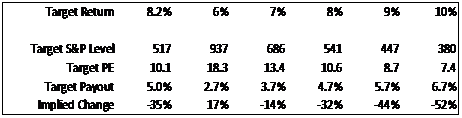
Assuming a long term inflation rate of 2% and a 50% normalized payout on trend earnings, today's S&P 500 level of 798 yields a long-term expected return of 6.5%.

Below are desired S&P 500 values at various return targets (I use 8.2% as the equilibrium target):

I maintain my position that the market only gets interesting at S&P levels below 600, and that seeing a value below 500 would be entirely plausible. Nominal stock market returns were exaggerated in the second half of the twentieth century due to high levels of inflation, which add to corporate earnings. I believe the pendulum will swing to lower inflation in the first several decades of the twenty-first century, which will increase the relative appeal of bonds at the expense of equities. A shift to bonds would also make sense for the aging populations of the developed countries as they rapidly near retirement.

The table below compares stock returns to other market yields (represented by the yields of various Vanguard fixed income mutual funds), and to what I consider equilibrium market yields:

The non-treasury fixed income market continues to offer decent values. The Vanguard Ginnie Mae fund is also appealing, as it is yielding 4.2% with the same credit risk as treasuries. (GNMAs have less price appreciation potential due to mortgage refinancing risk). If you don't have the stomach for high yield, muni bonds and high grade corporates offer pretty good risk-adjusted returns relative to equities.

The stock market is overvalued, potentially by alot.

John Mauldin has posted an article from Peter Bernstein about the historical relationship between dividend yields and treasury yields.  Prior to 1958, dividend yields always exceeded treasury yields.  Since that time, treasury yields have always exceeded dividend yields.

Charts:

Dividend Yields Versus Bond Yields, 1871 - 1967

Dividend Yields Versus Bond Yields, 1954 - 2008

He, correctly, I believe, ties the change to a change in the nature of inflation.  From 1800 to the 1950s, the price level in the US were basically unchanged.  It would go up during wars and down during depressions, but over the long term, prices were stable.  Monetary and fiscal policy changes during the post World War II era changed the nature of inflation so that prices rose every year, even in recessions, and the inflation rate became more volatile.

If you refer to my stock market valuation model, expected stock return equals dividend yield + long term rate of real profit growth + expected inflation.  If you look at the current spread of treasury yields to inflation protected securities, inflation is expected to be negative over the next five years, and about 1% over the next 10-30 years.  While I realize there has been a market dislocation in the TIPS market, given the deflationary forces affecting the financial system today, expecting falling to flat prices is perfectly reasonable.

So if I take today’s S&P 500 value of 904, I get a normalized dividend yield of 3.2%, a long term real earnings growth rate of 1.7% and an inflation rate of 1%, for a total expected return of 5.9%, nearly 2% less than investment grade corporate bond yields, which makes stocks a less-than-compelling investment.  To expect a long term return of 8%, you would need a dividend yield of 5.3%, which would imply a value of the S&P 500 of 521, or 42% below where it is today.  Ouch.

If you look at the pre-1958 era, normal dividend yields were between 4% and 6% and normal treasury yields were between 3% and 5%.  If we have figured out how to tame inflation, and that’s a big "if", of course, then it should be perfectly reasonable to expect a dividend yield of 5.3% from equities.  In that event, then bonds are a much more compelling buy today than stocks.  These types of structural shifts can take a long time to process, which would imply that the equity market is likely to grind sideways for years, slowly sapping investors’ energy.  The regulatory changes that are coming to the financial sector will almost certainly curtail credit creation, which will in turn curtail inflation, securities trading and speculation.

WE ARE IN A NEW ERA.  Be happy collecting interest and forget about the stock market until dividend yields are a percent or more above treasury yields.