2009 Outlook Part II – The trade deficit and the US debt machine

This post is a continuation of 2009 Outlook Part I – The Depression's Long Shadow

Our debt problem

At this point it's pretty obvious that the primary problem facing the United States in this financial crisis is our high level of indebtedness and the threat of debt deflation. In order to understand how to get out of our debt problem, it makes sense to look at how we got into the problem in the first place. The operative metric to look at is total debt to nominal GDP.

Of course, there's no real way to know what the ideal total debt to GDP figure is. If as a people we feel our government has gotten better at managing the risk in our economy, that recessions will be less frequent and shorter, that inflation will be consistently low and positive, that interest rates consistently low, and that asset prices will keep rising, we will be comfortable carrying a higher level of indebtedness. That is until we push it so far that the amount of risk increases and the level of indebtedness at which we're comfortable comes crashing down. As can be seen in the chart above, there have been two periods since 1952 during which the level of debt to GDP increased rapidly: (1) 1981-1989, when the level of debt to GDP increased from about 150% to 225%; and 1997-2008, when the level increased from 240% to 340%. If the history of investment manias is any guide, we should expect the financial effect of at least the entire 1997-2008 boom to be wiped away.

In order for our nation's debt to grow faster than GDP, we can (1) borrow money from abroad or (2) increase the leverage in our financial system. Increased leverage in the financial system can be measured by total financial debt to nominal GDP, which I will discuss in a later post. All the rest (consumer, business, government) is in nonfinancial debt to nominal GDP.

The debt stair steps

It's pretty easy to see the pattern in this graph. Nonfinancial debt rose from 120% of GDP to 140% of GDP by the mid 1960s, coming off a pretty low base during the postwar boom. It stays in a range of 135%-140% all the way to 1982 and then shoots to about 180% by the end of 1987. Then it basically stays at about 180% until the end of 1999, after which it climbs to 225% by the end of 2007. These were both about 25% increases.

What did these two periods have in common? They both had tax-cutting Republican presidents who also spent heavily on the military. They both had rapidly falling interest rates. They were both periods during which the US was running large trade deficits. Trade deficits coexist with an inflow of capital, as the current account deficit (mostly the trade deficit) by definition must equate to a capital account surplus (a purchase of US securities).

Why do we run trade deficits?

If the trade deficit is a major cause of our debt problem, it is worth understanding why we run trade deficits. The periods where the trade deficit starts to widen in the early 80's and late 90's clearly correlates with periods of a rising dollar. When the dollar returns to its equilibrium range between 85 and 95 on the real broad trade-weighted dollar index, the trade deficit begins to close.

Why did the dollar rise during those two periods? During both periods there were relatively high real interest rates, plus an explicit policy favoring a stronger dollar. During the 1980's, the US wanted to wring 1970's inflation from the system. During the mid 1990's, Robert Rubin imposed the "strong dollar" policy for no discernable reason whatsoever.

Why was the trade deficit in the 2000's were more severe than the deficit of the mid 1980's, when the dollar spike was more subdued? The answer is foreign intervention.


Source: Bank Credit Analyst

Clearly, you tend to get foreign official flows into dollar assets when the dollar is weakening. During the late 1980's and early 1990's, foreign official flows accounted for virtually all of the US's modest trade deficit of 1% or less of GDP. During the early 1980's and late 1990's, there was very little official foreign flow, as the rising dollar attracted private investment flows. From 2002 to 2008, however, there was a systematic effort by foreign governments to accumulate dollar reserves to promote a trade deficit in the US. The vast majority of the blame can be heaped on China, Japan and the oil producing countries, who from 2003 to 2008 were contributing 2.5% to 3% of GDP points to our trade deficit each year. Without these flows, our trade deficit would have run at a more modest 1-3% of GDP. What did the majority of these funds purchase in the last several years? Fannie Mae and Freddie Mac agency debt, which flowed into, you guessed it, the US housing bubble.

So we should blame China and Japan for the housing bubble, then, right? Partly, but not completely.

The role of Japan

Japan had a massive investment and real estate bubble in the late 1980s, like our NASDAQ and housing bubbles all rolled into one. When it popped, Japan was unable to stimulate domestic demand, because its consumer base was overleveraged from the real estate bubble. Also, because Japan was a more egalitarian society than the US during the roaring twenties, it couldn't follow the New Deal policy of taxing the savings of the rich to stimulate demand in the middle class. Japan had massive overcapacity in its business sector and a badly damaged banking sector, so it was difficult to stimulate investment there. Japan also suffered from deflation, not only a slow-rolling debt deflation as the government propped up wobbly banks, but also absolute price deflation caused by a strong currency.

The yen doubled in value against the dollar from 1985 to 1988 (at our urging as part of the Plaza Accords) and rose in value against gold all the way into the late 1990s. With domestic demand hobbled and prices falling, Japan instituted a massive infrastructure building program during the 1990s, most of which is now acknowledged to have been wasted on politically-connected projects. By the end of the 1990s, Japanese government debt to GDP has risen to around 100% of GDP. In the 2000s, Japan switched gears to focus on printing money ("quantitative easing") to fight deflation and support exports by holding its currency down. Printing money in the case of Japan meant printing yen to buy dollars. With zero percent official interest rates and an explicit pledge to hold down the currency against the dollar, the Bank of Japan issued a notice to hedge funds to short the yen and buy assets in other, higher-yielding foreign currencies like the dollar, pound, Australian dollar, New Zealand dollar and Icelandic Krona.

Robert Rubin's wave of destruction

In the mid-1990s, a number of Asian countries (ex. Japan) were doing pretty well. Their currencies were pegged to the dollar. They were following the classic development model of running capital account surpluses as they received high levels of investment from abroad. Much of the investment was in the form of dollar-based loans. The dollar spent 8 years in a relatively tight trading range, so that wasn't an issue. With the exception of Japan, most of the world economy was expanding in a relatively balanced fashion and the US was running only modest trade and budget deficits along with stable, low inflation.

In 1995, however, US Treasury Secretary Robert Rubin began cheerleading for a stronger dollar. As the dollar began to rise, it put pressure on emerging market currencies in Asia and Latin America that were trying to maintain currency pegs and had borrowed in dollars. Hedge funds began (rightly) betting that the currency pegs would be broken. Starting with the Thai Baht in 1997 through the Ruble default in 1998, the world currency system collapsed, saddling emerging market economies with huge dollar-based loans relative to their collapsed currencies. The IMF then imposed punishing austerity measures on these countries in exchange for bailouts. Emerging market countries can be forgiven for seeking a different policy path this decade after they were needlessly impoverished in the late 1990s.

The China model

The Chinese witnessed what happened to Japan (rising currency/deflation) and what happened to Korea and Southeast Asia (trade deficits/collapsed currencies) and decided to take a different path. They would emulate the export-based development model successfully utilized by Japan. Instead of allowing their currency to consistently rise over time (which has the effect of raising living standards and holding down prices, but can also lead to an unstable investment bubble and encourages imports and discourages exports), they would hold down their currency. To prevent their currency from rising, the Chinese limit currency convertibility. The central bank recycles export earnings into dollar-based securities, building reserves to protect their currency in times of distress. China has built up more than $1.2 trillion of reserves. Building currency reserves directly promotes a trade surplus for China and a trade deficit (via a capital account surplus) for the country issuing the reserve currency (mostly the United States). Such a strategy can only last so long, of course. Eventually, inflation pressures in China would become too great and/ or the United States would stagger under the weight of its increasing debt load. Both began to happen in 2007, with the US's debt burden becoming the greater of the two forces.

Reining in the trade deficit

As US demand has collapsed and energy prices have plunged, the US trade deficit has begun to narrow sharply. The problem is that now US exports are falling too. The goal going forward for the US needs to be to figure out how to restore domestic demand without having that demand spill abroad in the form of renewed trade deficits. I'll leave discussing how the mix of demand needs to change for a later post. Foreign countries also need to figure out how to stimulate domestic demand so that they become less reliant on exports to the US and import more from the US. A return to trade balances would at least help stabilize the US's debt to GDP ratio.

The US would bring its debt levels down if it began running trade surpluses. Given the current structure of the global economy, that may be a bridge too far, unfortunately. What the US can no longer tolerate, however, is foreign governments to purposely manipulating trade flows via the building of currency reserves. After 8 years of using diplomacy alone to try to deal with this issue, it may be time for the Obama administration to take a tougher line, perhaps via broad-based tariffs to offset the effect of currency manipulation. While I am a free trader by disposition, we can't stand by and allow other countries to basically cheat our businesses and workers.

A global solution to a global problem

The problem of global trade imbalances and currency instability is a global one, yet most currency and monetary policies are determined at the national level. The US Fed operates as if it serves the US alone. Since the dollar is the global currency, however, the Fed functions as a de facto global central bank. The US allows its currency to fluctuate widely to suit its own purposes, with dolorous effects on emerging market economies and US businesses. Yes, China, Japan and various petro-states are systematically manipulating their currencies, but in many ways these policies are a response to past interest rate and currency instability caused by the US Fed and Treasury.

While the US could seek to punish offending countries with tariffs, such a solution alone could result in retaliatory measures, a collapse of global trade and global depression. Instead, the US should offer to lead a global currency system based on stable currency values. Such a solution would by definition require coordinated global monetary policy, particularly between the US, Eurozone, Japan and the UK. Other emerging countries could allow their currencies to float against, or be pegged to, the major currencies. All currencies would need to be freely convertible and countries would not be allowed to build currency reserves beyond what may be needed to provide for currency stability. The IMF could also return to its traditional role of promoting currency stability. Emerging market countries should be given a seat at the table and most decisions should be made through the G-20 type of group as opposed to the anachronistic G-8.

Conclusion

I hope this essay establishes that (1) a large portion of our national debt problem comes from running trade deficits; (2) a major cause of the trade deficits has been artificial dollar strength, driven by US policy; and (3) that another cause of our trade deficits has been currency manipulation by foreign governments building large currency reserves. To fix the trade deficit problem, US currency policy should be (1) to promote a stable dollar, not a rising or widely fluctuating dollar; (2) to prevent foreign governments from building large dollar reserves; and (3) ideally create a global currency framework that would promote currency stability and reduce global imbalances, particularly by brining the emerging market countries in to the process as major stakeholders.

Next: Part III, shrink the stimulus, triple the TARP 

2009 Outlook Part I – The Depression’s Long Shadow

I've been having writer's block for the past three weeks as I've been trying to sit down and write my 2009 economic outlook. While in normal years, I could assess the state of the business cycle, look at asset prices and make a call. This year, however, we are caught in a web of epochal changes on par with the 1930s and 1940s or the 1860s and 1870s. The entire global economic system is threatening to break down, and for good reason. Since World War II the world has relied on the relentless increase of US consumer demand. The increase in US consumer demand has been driven by a relentless increase in US consumer indebtedness. Both of these forces have been deliberately fostered by US economic policy. Not surprisingly, US economic policy has been driven by the lessons learned in the Depression and articulated by two economic schools of thought, Keynesian and Monetarist. The Keynesian school articulated that the government should step in to fill the void in private demand during recessions. The Monetarist school posited that the central bank should step in to prevent a contraction in credit, and by extension the money supply, during downturns. Since the Depression both methods have been used liberally to fight recessions, mostly successfully, but have also been bastardized for political ends. The Keynesians have used policy to not only temporarily support demand during downturns, but to also promote permanent increases in consumer demand, particularly through the promotion of housing and consumer spending. The Monetarists have used policy asymmetrically, supporting credit during downturns but letting booms run unabated. As a result, dangerous imbalances have built up.

The other theme for the past 60 years has been the relentless expansion of the financial sector, first from absurdly low levels after the beating it took during the Depression and the New Deal, then into the massive expansion of the past 30 years. There has been a great deal of innovation in the financial sector, making the US the most efficient allocator of capital in the world. The financial sector has also become dangerously unstable and has magnified the global boom and bust cycles of the past 30-40 years. A series of constantly shifting imbalances has ruled the global economy during this time. Much of this instability has been tolerated because, for the most part, it has been during a virtuous cycle of rising global living standards supported by the US's willingness to lever itself up. Now that the cycle may be turning vicious, we could be in for 10-20 years of serious global crisis if world leaders don't get together to restructure the world economy. Until it becomes clear that such a change is occurring, caution will be the proper stance.

Because of the momentousness of the trend changes underway, I have been forced to break up my analysis into several parts. Part I will set the context of how today's economic policy mix was shaped by the Depression. Part II will discuss the US trade deficit and indebtedness. Part III will discuss consumption and investment and the sources of GDP growth. Part IV will discuss the dollar and inflation. Part V will be a policy manifesto for the new era.

Part I – The Depression's Long Shadow

The effect of the Depression on policy today

There has been a great deal of commentary that has compared today's situation to that of the Great Depression. There are similarities. First, there is the great debt overhang that has built up, resulting in the threat of debt deflation. Second, we are in similar position in the Kondratiev Cycle, moving from the good disinflation to the bad disinflation phase (if you believe in that sort of thing, which I actually do). There is also the high wealth disparity that has built up over the course of a long bull market and the obvious switch from a Republican-dominated government to a Democratically-dominated one.

There are big differences, however, as well. The US's macroeconomic position is much different now than it was at that time. During the early 1900s the United States was in a position more similar to Japan in the 1980s or China today. It was a rising, mercantilist power that ran big trade surpluses and was a net creditor to the rest of the world. It had a relatively small government sector that did not greatly interfere in the private economy. The government had long run balanced budgets and was historically tight-fisted. Most government revenue came from protective tariffs and the use of income taxes was limited. The US had a huge amount of excess production capacity that sat idle when domestic demand was insufficient to take up the slack after world trade collapsed in the Depression. The US was on the gold standard and value of the dollar had remained unchanged vs. gold at $20.67 since the revolution (with blips during major wars), even though the economy had grown many times over, and up to the start of the Depression the general price level was basically the same as it had been in 1800. It is also important to note that debt to GDP wasn't that high at the beginning of the Depression (it went from 140% of GDP at the beginning of World War I to 160% by the end of the 1920s), it was only after a massive collapse in the economy and debt deflation that it rose to 250% of GDP by 1933, as shown here. It was as the economy shrank faster than the nation's debt load, that the ratio of debt to GDP rose.

The policies of the New Deal were designed to correct some of the imbalances that had built up over the previous 70 years. In the era prior to the Great Depression, the core economic policies of the United States were designed to encourage manufacturing production. The primary form of tax was the protective tariff, which encouraged domestic production and taxed consumption of imports. Large trusts were formed to limit domestic price competition. To counter the pressure on laborers' wages, from competition in the 1920s the government passed highly restrictive immigration laws. World War I, however, had thrown the rest of the world system into chaos. During the War, the US lent large sums of money to its allies, which it could then in turn use to by US-manufactured war materiel. The US thus ran very high trade surpluses and built up a stock of European capital. After the War, the allies began to repay their loans, sending money back into the United States. As the money flowed back into the US banking system, it was lent out and supported the great production, consumption and asset boom of the 1920s. When it ran too far, it began to collapse into a classic debt deflation. As domestic demand retreated with the supply of money and credit, the US government tried to keep the party going the only way it knew how: by raising tariffs to support domestic industry, raising taxes to keep the budget balanced, and keeping interest rates high to protect the gold standard.

In not doing those things you get the three US ideologies of the Era since the New Deal: free trade Globalism, Keynesianism and Monetarism.

We encourage open world trade, even if other countries manipulate our willingness to do so with mercantilist policy. We use government policy to encourage increasing domestic demand: deficit spending, policies that support consumption at the expense of saving and investment, and policies that encourage borrowing money to buy houses. We manipulate the money supply to support ever-rising indebtedness and prices.

The policies of the New Deal were appropriate for the situation the country was in then. Reduce the value of dollar to fight deflation. Establish the SEC to increase investor confidence. Establish the FDIC to prevent bank runs. Establish home loan banks to support housing prices and financing. Break up the highly concentrated financial system to reduce risk. Use government money to invest in infrastructure when private investment demand dried up. Establish Social Security and unemployment insurance to reduce consumer risk so they consume more. Encourage unions to fight for higher wages. Use the progressive income tax to tax the large pool of savings at the high end to support policies that help lift domestic demand. Encourage investment in rural areas. Be (somewhat) willing to run government deficits to support demand when private demand is not present.

The road to excess

These policies all made sense at the time and most still do. The problem is that the constituencies that support these policies became more powerful as time moved on and the policies have gotten pushed too far. Even now, when it is obvious that as a nation we need to save more and spend less, that we have too many houses relative to demand, that we consume more than we produce, that our debt level has risen to 350% of GDP from 150% as recently as 1980, that we have seen our currency fall 98% vs. an ounce of gold since FDR took office…what are we doing? We are seeing our policymakers insist that the cure lies with policies that spend money we don't have, try to support housing prices, try to encourage more consumption, try to encourage more lending and borrowing and devalue our currency further to maintain a positive level of inflation. Let me use pictures to drive the point home:

How does a country whose demand exceeds production by 5% of GDP suffer from a lack of demand?


Why should over-indebted consumers be encouraged to keep consuming?

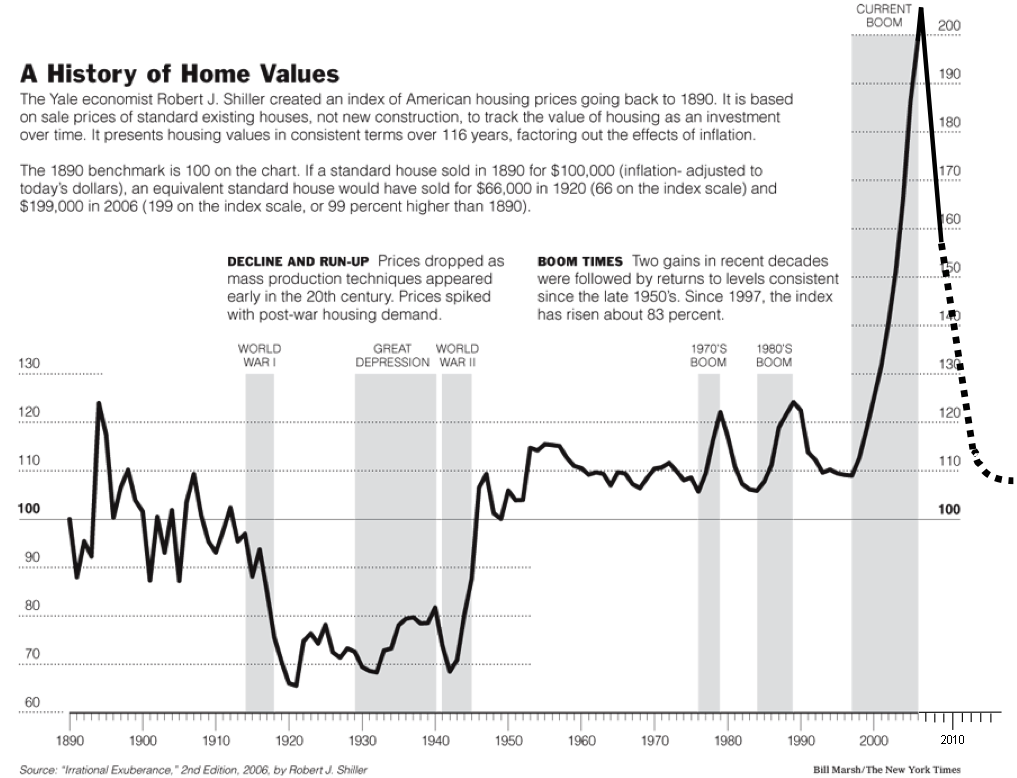
How exactly are we supposed to support home values when they are still 30% above their long term trend?

How does a country whose currency has lost 95% of its value relative to gold in the past 40 years have a deflation problem?

What the current situation means for policy makers

In an effort to prevent near term collapse, we are doing exactly the opposite of what we need to do as a country to get ourselves out of our mess. Instead, we are fighting, spending literally trillions of dollars, just for the privilege of staying in the mess we're in. It is madness.

We need to balance our policies to reverse or halt these trends. We need policies that:

  1. Improve the terms of trade for the US to run a trade surpluses or a neutral trade deficit
  2. Encourage domestic saving at the expense of consumption
  3. Roll back policies that favor residential investment at the expense of business investment
  4. Encourage a sound dollar, zero to low inflation, and a sound, stable financial system

Because these are the types of policies that exacerbated the Great Depression, they are despised by the elites that learned about the Great Depression in graduate school. It is no longer fashionable to study the period between the Civil War and the Great Depression, even though in many ways it was America's economic golden age. I would argue that cyclically, today we are in a period more similar to the depression of the 1840s, after Andrew Jackson's experiment with wildcat banking (read paper money and hedge funds), Manifest Destiny and the yeoman farmer (read real estate speculation), and low tariffs, open immigration and the support of large-scale agriculture and mining. Out of this collapse would rise the northern-based Republican Party, which favored sound money, internal improvements and infrastructure investments, high tariffs, restricted immigration, the support of manufacturing, and, oh yeah, the abolition of slavery. The blueprint for success is there for the taking.

Next: Part II – The trade deficit and the US debt machine

Inflation versus Deflation

I’ve been asked frequently whether I view inflation or deflation to be the more likely outcome to the credit crisis. My view has been that deflation is more likely, but that circumstances could certainly change.

Left to its own devices, with no government intervention, we would collapse into a debt-deflation spiral. Why? Because as the economy turns and risk premia rise, highly-leveraged banks would be forced to sell assets in a scramble for cash to cover short-term loans, which would in turn drive down asset prices further, setting off further collateral calls from lenders and investors, forcing more asset sales and so on. In fact, this is what’s happening right now, and the government is intervening about as much as it can to stop it.

The debt deflation spiral turns into price deflation because the inability to borrow causes demand to collapse. Firms and consumers hoard cash to pay off debts instead of investing in their business or consuming. The value of cash rises and everything else falls. Eventually, things get so cheap and the potential returns so high, that “strong hands” step back in to the market, stopping the cycle.

We are particularly vulnerable a prolonged debt deflation now, because the US economy is more leveraged than it has ever been, particularly the financial system and US consumers.

Ironically, the US government is not that highly leveraged as a percent of GDP, at roughly 60% today vs. well over 100% during World War II, and businesses are not leveraged outside of the norm.

We got to this point because, after the Great Depression, we have set up our entire system to avoid deflation at all costs. We have used monetary, fiscal and currency policy to fight potential contractions in private credit. In other words, we have relentlessly fought off deflation with inflation, levering up our economy to the point where it can’t go any further. I would argue that we are not facing a shortage of demand, as much as we are retreating from artificially high demand fed by artificially abundant credit.

Consumers will be forced to deleverage, first as housing prices fall and then as baby boomers prepare for retirement. Additionally, we are likely to see a contraction in the GSE programs and new regulations that limit “subprime” lending in all forms. The financial system will also be forced to deleverage, first as asset prices fall and then as a new regulatory regime limiting the leverage of banks, hedge funds, and GSEs is implemented. The US government does have scope to leverage itself, which is what it is doing.

The fear among the inflation hawks is that the recent large government deficits and expansion of the Fed’s balance sheet will eventually result in high inflation. While this is possible, it would take a concerted effort by our government to let inflation spin out of control. Why? Because as the economy improves, the government will face political (and fiscal) pressure to sell its bank investments back into the private markets and the Fed will face pressure to shrink its balance sheet back down and to trade its recently-acquired risk assets for Treasuries. These sales will restrict growth in the monetary aggregates. While I don’t have a ton of confidence in the economic skills of our elected officials, I give them more credit than to think that they will purposely send us down the road of hyperinflation.

In addition, without a re-leveraging of the financial system or consumer balance sheets, we are unlikely to return to renewed credit inflation in the near-to-intermediate term. I therefore believe that we are more likely to see a period of price declines in the near term followed by a long period of subdued inflation and relatively low interest rates.

A call for sound money

The Wall Street Journal is using the "Bretton Woods II" conference tomorrow to advocate for currency stability and sound money on its op-ed pages.  Here and here.  (Subscription required.)

While the Europeans are trying to foist their system upon us, including market regulation and "tax harmonization", the US should resist.  Instead we should keep it simple and focus on three things:

  1. Coordination between the US, EU, UK, BoSwitzerland and BoJ to stabilize monetary policy and currency values.  Currency values should be relatively stable relative to each other and to gold.
  2. Limiting the ability of countries to build currency reserves for the purpose of promoting current account surpluses.  Return the IMF to its role of supporting smaller currencies as a reserve holder of last resort.
  3. Coordinating bank reserve requirement policies to be counter-cyclical to damp wild market swings from debt inflation to debt deflation and back.

These three changes would reduce inflation, reduce wild swings in credit creation/destruction, and lead to more stable balance-of-payments between nations.  It will make investing less exciting, particularly for macro hedge funds, but will make business planning a great deal easier.

The rebirth of deflation

Again, this a bit technical, but if you’re an econ nerd like me, you’ll find this informative.

Download the_rebirth_of_deflation.pdf

Lays out a pretty good case to expect the price level to be negative in the US next year.  For all the negative connotation with the word "deflation", a year or two of lower prices can actually be beneficial in that it increases consumers’ purchasing power, particularly for food, gas, clothing and shelter.

Doesn’t sound too bad, now does it?  It should be noted that the economic elite in this country have a vested interest in promoting inflation, so the Fed and Treasury and Congress will be fighting it tooth-and-nail.

Maybe Ron Paul is on to Something

So the bailout bill fails, and everybody freaks out.  There is pretty good reason to freak out.  Our whole system is built upon a mountain of credit, much of it short-term credit, so when the mountain gives way, the whole edifce comes crashing down.  Fair enough.  The government needs to "do something".

Something else is bothering me though.  What kind of system do we have, if that system is subject to collapse if it doesn’t receive a $700 billion injection from the federal government?

Maybe Ron Paul is right to bang on about our monetary policy that is designed to promote ever-increasing levels of leverage, currency inflation and trade deficits.  Oh yeah, and our fiscal policy that perpetually runs big deficits and seems so manifestly corrupt.  How did things get so unstable?

It’s not just the "anything goes", laissez-faire regulatory regime of the Bush Adminsitration that got us here.  While the extremely loose financial market regulation of the last 7 years brought everything to a head, it was an endpoint we were destined to reach all along.  This process didn’t start in 2000 and it didn’t start in 1980.  It started back in the late 1800s and became the dominant system in the 1930s.

Our current economic system is based on three basic principles: (1) the promotion of inflation; (2) the promotion of consumption and homeownership and (3) relatively open immigration.  This economic system has been traditionally promoted by southern and western states, first by the Democratic Party, then by both parties.

Much of the current government edifce is built to promote inflation, consumption and homeownership while discouraging deflation and savings.  The federal reserve, the progressive income tax, Fannie Mae and Freddie Mac, Social Security, deficit spending, the abandonment of the gold standard, Medicare, the mortgage interest deduction, homestead laws, unionism, high estate tax rates, generous public pensions, low tariffs, loose bankruptcy laws, the interstate highway system, the earned income tax credit, etc.: all are designed to promote inflation, redistribute income to promote consumption and/or stimulate consumer borrowing for homeownership and consumption. Also, think about what happens every time we have an economic downturn…the Fed lowers rates to try to encourage people to borrow against their houses and/or the government sends out rebate checks for consumers to spend.

None of these things are bad, per se.  They’ve just been building up over the past 70 years and have been taken as far as they can go.  The American consumer is as leveraged as he or she can possibly get.  The US government has some scope to borrow more, but not that much scope.  Clearly the US financial system is overleveraged and needs to retrench.  The US balance of payments has been running a deficit for most of the last 30 years, so it’s probably not advisable to increase our borrowing from abroad, either.

On the other hand, US businesses are actually in good shape and are the most competitive in the world.  We should be actively encouraging more business and production to be conducted in the United States.

[It should also be noted that I acknowledge that the old Republican system of high tariffs, restricted immigration and the gold standard collapsed in the 1930s when it, too, was taken too far.  These systems tend to have about 70 years in the sun before they collapse.]

What should a new system look like?  It should promote savings, investment, technological innovation and exports.

  • The tax code should be used to encouraged savings, perhaps moving to a progressive consumption tax
  • Low corporate tax rates and generous deductions for capital expenditures to encourage production in the US
  • Financial regulations that target the leverage of financial companies
  • Remove the full employment mandate from monetary policy a set an inflation target or price rule
  • Currency policy that targets a stable dollar relative to other currencies and limits big swings in international capital flows
  • Federally-supported investment in internal improvements, particularly our transportation, communications and energy infrastructure
  • Funding for high-tech, health, space and military research
  • Encourage more defense spending by our allies and sell them high-tech military equipment
  • Scale back on US defense spending, consider a more limited direct role for the US military
  • Scale back the home mortgage interest deduction and/or eliminate Fannie Mae and Freddie Mac
  • Bring the estate tax down to a non-confiscatory level
  • Make Social Security needs-based and potentially cut the payroll tax
  • Promote skills training and certification throughout a worker’s lifetime as part of the social security and/or unemployment insurance program
  • Have a health system based on either consumer-purchased insurance or government-provided insurance and remove that burden from employers

So I’m basically saying we should have a progressive, more globalist version of Ron Paul’s program of sound money, less debt, and low taxes.

New York tax revenues go “poof”

Due to large losses at financial firms in the past two years, New York City and State face a huge revenue shortfall as banks stop paying taxes and in many cases are filing for refunds, Bloomberg News reports.  Many large institutions will be able to carry forward their losses to offset cash taxes for 5 or 6 years.  We are starting to see just how geared the New York tax base is to the fortunes Wall Street firms and their employees.  This is particularly tough given how geared the earnings of those insitutions are in the first place.

If, as I believe, Wall Street is about to go through a permanant downsizing and restructuring, New York will be in for a long reckoning indeed.  As someone of the generally anti-tax persuasion, I hope New York is able to navigate this crisis by downsizing and restructuring its preposterously bloated government bureaucracy.  Alas, knowing New York’s politics and history, I suspect it will be the private citizenry that will end up getting milked instead.

Random thoughts and links on the dollar, credit, brainwaves, income inequality and Comcast

Catching up on my reading I came across some interesting tidbits, which are shared below.

The Economist has published its Big Mac index of Purchasing Power Parity, and to no surprise, it shows the European currencies as massively overvalued and the Asian currencies as massively undervalued, with the dollar, on average, just about right.

In the same issue, the Economist notes that the seemingly large rise in the inequality of real incomes in the US is likely overstated, as the rich have experienced much more inflation in the things they buy than the middle class have experienced in the things they buy over the past twenty years.  This largely explains why the issue hasn’t gotten much grab politically.  Interestingly, the trend has changed recently with the rise in commodity and import prices greatly impacting the middle class, thus their generally foul mood on the economy over the past several years.  Both parties don’t get it: INFLATION is the biggest political issue, more specifically than the economy, which is borne out in polls that break out people’s ranking of top issues.  They consistently rank gas prices, food prices and health care prices as the top three economic issues.  Note that’s health care PRICES, not ACCESS.

In this Business Week article, Charles Morris, author of the excellent book Trillion Dollar Meltdown, outlines his assessment and prescription for the credit crisis.  As usual, he is spot on.

In the most recent Business Week, they review a new product that allows you to control your computer by only using your brain.  Behold the future.

In this week’s Barrons, Michael Santoli posits that perhaps the big capitulation everyone in the markets are waiting for may not happen, instead we all may suffer a slow-motion drift sideways-and-down that may lead market participants to drift away out of boredom. I agree.

"Ultimately, the trajectory of the market, amid only equivocal signs that it’s trying to bottom, might hinge on whether investors finally make it all the way to the opposite of love, which the old saying tells us is not hate but indifference. It’s hard to argue we’re quite there. So many folks have been sitting in vigil for solid evidence of a climactic panic selloff and recovery (guilty as charged here) that maybe a sort of slow-motion give-up phase will be the crowd-humbling scenario that plays out instead."

Also in this week’s Barrons, Eric Savitz reminds us, contrary to current market sentiment, how badly the cable companies are kicking the phone companies’ behinds in all things delivered by a wire.  Not that it makes me feel better about the losses I’ve taken since buying Comcast stock in September 2007.

Taxpayers: congratulations, you will soon own Fannie Mae and Freddie Mac!

As I outlined in my previous post Deflation Avoided?, I highlighted the massive deflationary force sweeping through the land.  If you click on the link to my market update, presented internally here at Catalyst the week before the demise of Bear Stearns, I highlight the ludicrously irresponsible leverage levels of not only the investment banks, but also the GSEs (also known as Fannie Mae and Freddie Mac).  As I said at the time, I find it highly unlikely that the investment banks or the GSEs will survive in their current form.

Now the storm is circling around the GSEs and Lehman Brothers.  There is no real reason for Lehman Brothers to exist as a standalone company and it likely won’t much longer.  It only survives today because the list of potential buyers who are healthy enough is so short and the value of the target’s equity so uncertain that it is hard to envision a deal happening until it has to, with Lehman’s equity basically wiped out.  Sorry to my friends at Lehman, but that’s the fate the company has earned, anyway.

Fannie Mae and Freddie Mac are another matter altogether.  They have debt and guarantees outstanding roughly equivalent to that of the Treasury of the United States of America.  That debt is held against collateral that is losing value, and the companies are basically as thinly capitalized as Bear Stearns was.  They are so instrumental the functioning of the mortgage market that the government just increased their role in keeping the market afloat.  If they were allowed to just collapse it would literally bring the apocalypse.  I don’t mean a figurative apocalypse in the sense of another Great Depression…I mean like a chaos-would-reign-over-the-Earth type of apocalypse.

The good news is everyone knows this, so the government will ride to the rescue.  The bad news is the government is funded by you, the taxpayer, and it will mean our national debt will double overnight.  On the other hand, the good news to that is the bond market has always looked at agency debt as having a government guarantee.  Another piece of good news is that the debt is collateralized by our houses (which are losing value but not all their value) and we already owed the money anyway, so its not like we just went out and borrowed $5 trillion and shot it out into space.

Hopefully we will learn a lesson from this.  Any rational person who really thought about it knew this would happen someday.  You had a for-profit company enjoying the benefit of an implicit government guarantee on its debt, so it could borrow unlimited quantities at rate below it actual level of risk.  In pursuit of pure self-interest, you as the management team would naturally decide to issue yourself tons of stock options, leverage your company as much as possible to make as much money in as short a period of time as possible.  When grumpy Republicans try to regulate your balance sheet because you’re taking on too much risk, lavish money on your Democratic friends to keep them at bay.  Pay yourself $75MM to $100MM per year to congratulate yourself for the great public service you are doing.

Right there you have the last 15 years biography of former Fannie Mae CEO Franklin Raines and his cronies at the GSEs.  Well done, Franklin, I hope you’re enjoying the beach.  Back here in the real world we’ll just watch the value of our houses decline and bank lending seize up.