
2009 Outlook Part I – The Depression’s Long Shadow

I've been having writer's block for the past three weeks as I've been trying to sit down and write my 2009 economic outlook. While in normal years, I could assess the state of the business cycle, look at asset prices and make a call. This year, however, we are caught in a web of epochal changes on par with the 1930s and 1940s or the 1860s and 1870s. The entire global economic system is threatening to break down, and for good reason. Since World War II the world has relied on the relentless increase of US consumer demand. The increase in US consumer demand has been driven by a relentless increase in US consumer indebtedness. Both of these forces have been deliberately fostered by US economic policy. Not surprisingly, US economic policy has been driven by the lessons learned in the Depression and articulated by two economic schools of thought, Keynesian and Monetarist. The Keynesian school articulated that the government should step in to fill the void in private demand during recessions. The Monetarist school posited that the central bank should step in to prevent a contraction in credit, and by extension the money supply, during downturns. Since the Depression both methods have been used liberally to fight recessions, mostly successfully, but have also been bastardized for political ends. The Keynesians have used policy to not only temporarily support demand during downturns, but to also promote permanent increases in consumer demand, particularly through the promotion of housing and consumer spending. The Monetarists have used policy asymmetrically, supporting credit during downturns but letting booms run unabated. As a result, dangerous imbalances have built up.

The other theme for the past 60 years has been the relentless expansion of the financial sector, first from absurdly low levels after the beating it took during the Depression and the New Deal, then into the massive expansion of the past 30 years. There has been a great deal of innovation in the financial sector, making the US the most efficient allocator of capital in the world. The financial sector has also become dangerously unstable and has magnified the global boom and bust cycles of the past 30-40 years. A series of constantly shifting imbalances has ruled the global economy during this time. Much of this instability has been tolerated because, for the most part, it has been during a virtuous cycle of rising global living standards supported by the US's willingness to lever itself up. Now that the cycle may be turning vicious, we could be in for 10-20 years of serious global crisis if world leaders don't get together to restructure the world economy. Until it becomes clear that such a change is occurring, caution will be the proper stance.

Because of the momentousness of the trend changes underway, I have been forced to break up my analysis into several parts. Part I will set the context of how today's economic policy mix was shaped by the Depression. Part II will discuss the US trade deficit and indebtedness. Part III will discuss consumption and investment and the sources of GDP growth. Part IV will discuss the dollar and inflation. Part V will be a policy manifesto for the new era.

Part I – The Depression's Long Shadow

The effect of the Depression on policy today

There has been a great deal of commentary that has compared today's situation to that of the Great Depression. There are similarities. First, there is the great debt overhang that has built up, resulting in the threat of debt deflation. Second, we are in similar position in the Kondratiev Cycle, moving from the good disinflation to the bad disinflation phase (if you believe in that sort of thing, which I actually do). There is also the high wealth disparity that has built up over the course of a long bull market and the obvious switch from a Republican-dominated government to a Democratically-dominated one.

There are big differences, however, as well. The US's macroeconomic position is much different now than it was at that time. During the early 1900s the United States was in a position more similar to Japan in the 1980s or China today. It was a rising, mercantilist power that ran big trade surpluses and was a net creditor to the rest of the world. It had a relatively small government sector that did not greatly interfere in the private economy. The government had long run balanced budgets and was historically tight-fisted. Most government revenue came from protective tariffs and the use of income taxes was limited. The US had a huge amount of excess production capacity that sat idle when domestic demand was insufficient to take up the slack after world trade collapsed in the Depression. The US was on the gold standard and value of the dollar had remained unchanged vs. gold at $20.67 since the revolution (with blips during major wars), even though the economy had grown many times over, and up to the start of the Depression the general price level was basically the same as it had been in 1800. It is also important to note that debt to GDP wasn't that high at the beginning of the Depression (it went from 140% of GDP at the beginning of World War I to 160% by the end of the 1920s), it was only after a massive collapse in the economy and debt deflation that it rose to 250% of GDP by 1933, as shown here. It was as the economy shrank faster than the nation's debt load, that the ratio of debt to GDP rose.

The policies of the New Deal were designed to correct some of the imbalances that had built up over the previous 70 years. In the era prior to the Great Depression, the core economic policies of the United States were designed to encourage manufacturing production. The primary form of tax was the protective tariff, which encouraged domestic production and taxed consumption of imports. Large trusts were formed to limit domestic price competition. To counter the pressure on laborers' wages, from competition in the 1920s the government passed highly restrictive immigration laws. World War I, however, had thrown the rest of the world system into chaos. During the War, the US lent large sums of money to its allies, which it could then in turn use to by US-manufactured war materiel. The US thus ran very high trade surpluses and built up a stock of European capital. After the War, the allies began to repay their loans, sending money back into the United States. As the money flowed back into the US banking system, it was lent out and supported the great production, consumption and asset boom of the 1920s. When it ran too far, it began to collapse into a classic debt deflation. As domestic demand retreated with the supply of money and credit, the US government tried to keep the party going the only way it knew how: by raising tariffs to support domestic industry, raising taxes to keep the budget balanced, and keeping interest rates high to protect the gold standard.

In not doing those things you get the three US ideologies of the Era since the New Deal: free trade Globalism, Keynesianism and Monetarism.

We encourage open world trade, even if other countries manipulate our willingness to do so with mercantilist policy. We use government policy to encourage increasing domestic demand: deficit spending, policies that support consumption at the expense of saving and investment, and policies that encourage borrowing money to buy houses. We manipulate the money supply to support ever-rising indebtedness and prices.

The policies of the New Deal were appropriate for the situation the country was in then. Reduce the value of dollar to fight deflation. Establish the SEC to increase investor confidence. Establish the FDIC to prevent bank runs. Establish home loan banks to support housing prices and financing. Break up the highly concentrated financial system to reduce risk. Use government money to invest in infrastructure when private investment demand dried up. Establish Social Security and unemployment insurance to reduce consumer risk so they consume more. Encourage unions to fight for higher wages. Use the progressive income tax to tax the large pool of savings at the high end to support policies that help lift domestic demand. Encourage investment in rural areas. Be (somewhat) willing to run government deficits to support demand when private demand is not present.

The road to excess

These policies all made sense at the time and most still do. The problem is that the constituencies that support these policies became more powerful as time moved on and the policies have gotten pushed too far. Even now, when it is obvious that as a nation we need to save more and spend less, that we have too many houses relative to demand, that we consume more than we produce, that our debt level has risen to 350% of GDP from 150% as recently as 1980, that we have seen our currency fall 98% vs. an ounce of gold since FDR took office…what are we doing? We are seeing our policymakers insist that the cure lies with policies that spend money we don't have, try to support housing prices, try to encourage more consumption, try to encourage more lending and borrowing and devalue our currency further to maintain a positive level of inflation. Let me use pictures to drive the point home:

How does a country whose demand exceeds production by 5% of GDP suffer from a lack of demand?


Why should over-indebted consumers be encouraged to keep consuming?
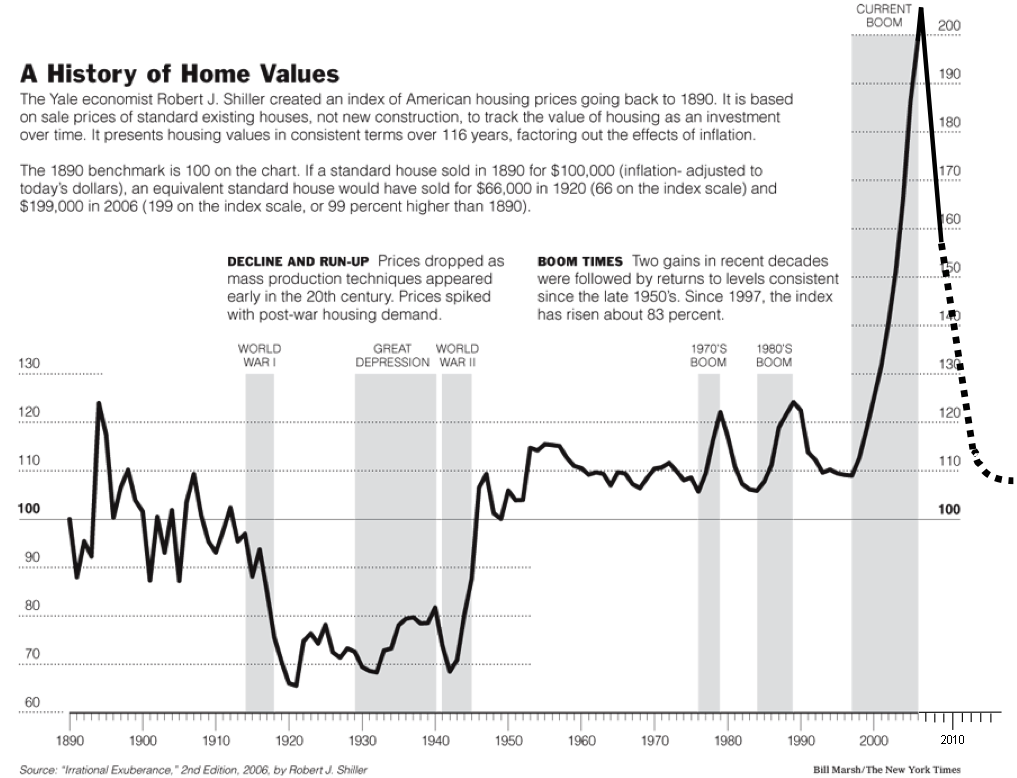
How exactly are we supposed to support home values when they are still 30% above their long term trend?

How does a country whose currency has lost 95% of its value relative to gold in the past 40 years have a deflation problem?

What the current situation means for policy makers

In an effort to prevent near term collapse, we are doing exactly the opposite of what we need to do as a country to get ourselves out of our mess. Instead, we are fighting, spending literally trillions of dollars, just for the privilege of staying in the mess we're in. It is madness.

We need to balance our policies to reverse or halt these trends. We need policies that:

  1. Improve the terms of trade for the US to run a trade surpluses or a neutral trade deficit
  2. Encourage domestic saving at the expense of consumption
  3. Roll back policies that favor residential investment at the expense of business investment
  4. Encourage a sound dollar, zero to low inflation, and a sound, stable financial system

Because these are the types of policies that exacerbated the Great Depression, they are despised by the elites that learned about the Great Depression in graduate school. It is no longer fashionable to study the period between the Civil War and the Great Depression, even though in many ways it was America's economic golden age. I would argue that cyclically, today we are in a period more similar to the depression of the 1840s, after Andrew Jackson's experiment with wildcat banking (read paper money and hedge funds), Manifest Destiny and the yeoman farmer (read real estate speculation), and low tariffs, open immigration and the support of large-scale agriculture and mining. Out of this collapse would rise the northern-based Republican Party, which favored sound money, internal improvements and infrastructure investments, high tariffs, restricted immigration, the support of manufacturing, and, oh yeah, the abolition of slavery. The blueprint for success is there for the taking.

Next: Part II – The trade deficit and the US debt machine

Inflation versus Deflation

I’ve been asked frequently whether I view inflation or deflation to be the more likely outcome to the credit crisis. My view has been that deflation is more likely, but that circumstances could certainly change.

Left to its own devices, with no government intervention, we would collapse into a debt-deflation spiral. Why? Because as the economy turns and risk premia rise, highly-leveraged banks would be forced to sell assets in a scramble for cash to cover short-term loans, which would in turn drive down asset prices further, setting off further collateral calls from lenders and investors, forcing more asset sales and so on. In fact, this is what’s happening right now, and the government is intervening about as much as it can to stop it.

The debt deflation spiral turns into price deflation because the inability to borrow causes demand to collapse. Firms and consumers hoard cash to pay off debts instead of investing in their business or consuming. The value of cash rises and everything else falls. Eventually, things get so cheap and the potential returns so high, that “strong hands” step back in to the market, stopping the cycle.

We are particularly vulnerable a prolonged debt deflation now, because the US economy is more leveraged than it has ever been, particularly the financial system and US consumers.

Ironically, the US government is not that highly leveraged as a percent of GDP, at roughly 60% today vs. well over 100% during World War II, and businesses are not leveraged outside of the norm.

We got to this point because, after the Great Depression, we have set up our entire system to avoid deflation at all costs. We have used monetary, fiscal and currency policy to fight potential contractions in private credit. In other words, we have relentlessly fought off deflation with inflation, levering up our economy to the point where it can’t go any further. I would argue that we are not facing a shortage of demand, as much as we are retreating from artificially high demand fed by artificially abundant credit.

Consumers will be forced to deleverage, first as housing prices fall and then as baby boomers prepare for retirement. Additionally, we are likely to see a contraction in the GSE programs and new regulations that limit “subprime” lending in all forms. The financial system will also be forced to deleverage, first as asset prices fall and then as a new regulatory regime limiting the leverage of banks, hedge funds, and GSEs is implemented. The US government does have scope to leverage itself, which is what it is doing.

The fear among the inflation hawks is that the recent large government deficits and expansion of the Fed’s balance sheet will eventually result in high inflation. While this is possible, it would take a concerted effort by our government to let inflation spin out of control. Why? Because as the economy improves, the government will face political (and fiscal) pressure to sell its bank investments back into the private markets and the Fed will face pressure to shrink its balance sheet back down and to trade its recently-acquired risk assets for Treasuries. These sales will restrict growth in the monetary aggregates. While I don’t have a ton of confidence in the economic skills of our elected officials, I give them more credit than to think that they will purposely send us down the road of hyperinflation.

In addition, without a re-leveraging of the financial system or consumer balance sheets, we are unlikely to return to renewed credit inflation in the near-to-intermediate term. I therefore believe that we are more likely to see a period of price declines in the near term followed by a long period of subdued inflation and relatively low interest rates.

Save General Motors

As General Motors and Chrysler careen toward insolvency, we the taxpayers are being asked to step in and toss them a lifeline.  The problem is that the American public instincitvely understands that the American auto industry is rife with outdated business practices that need to undergo major structural reform, and the public is right.  I think most of us, however, also think its important to have an American-based auto industry, even if that impulse is purely based on nationalist sentiment.  In the end, the American public would like to see two strong American car companies emerge that can compete with Toyota, Honda, Mercedes and BMW on the global stage.  We should figure out a way for General Motors and Ford to emerge on the other side of this recession, properly structured to compete in the auto industry of the future.

General Motors’ core problem is that it is caught in a web of relationships that were put in place back when it was the dominant producer of cars in the United States.  (Chrysler, on the other hand, is just a plain old weak company.)  GM created several brands to provide customers with diversity of choice (back before there was real diversity from foreign producers), and therefore now is hobbled with too many dealerships, excess production capacity, and an inefficient process for new model development.  It also was caught in the great false assumption of the post WWII period: that production capacity and employment was permanent, so that management and their employees are enemies engaged in a struggle to divide the spoils, rather than a partnership to compete against the likes of Toyota and Honda.

Through that prism, the way these companies have been run starts to make sense.  They can’t cut capacity, because they have a contractural need to maintain their network of dealers, their huge employee bases and their huge number of retirees.  Yes, the management that agreed to those contracts was short-sighted, but they were also dealing with what appeared to be reality at the time.  As fiduciaries, management has run the business to avoid bankrupcty as long as possible.  Either way, bankruptcy was inevitable, and has been since the 1970s.  That time has now come.

Andrew Ross Sorkin of the New York Times lays out how Chapter 11 can work while saving General Motors and "merging in" Chrysler.  GM would be reduced to four brands: Cadillac, Chevy, Buick (big in China) and Jeep.  In my view, Ford should also ditch Mercury and be left with Ford, Lincoln and Volvo.  Production capacity, the dealer networks and the employee base would be sized to make sense for the size of the industry today.  The government would facilitate this process by providing a DIP loan for a pre-packaged Chapter 11 restructuring.  As an American, I would be happy to see two, strong, restructured American car companies emerge on the other side of this crisis, rather than maintaining the three "zombie" companies that exist today.

A call for sound money

The Wall Street Journal is using the "Bretton Woods II" conference tomorrow to advocate for currency stability and sound money on its op-ed pages.  Here and here.  (Subscription required.)

While the Europeans are trying to foist their system upon us, including market regulation and "tax harmonization", the US should resist.  Instead we should keep it simple and focus on three things:

  1. Coordination between the US, EU, UK, BoSwitzerland and BoJ to stabilize monetary policy and currency values.  Currency values should be relatively stable relative to each other and to gold.
  2. Limiting the ability of countries to build currency reserves for the purpose of promoting current account surpluses.  Return the IMF to its role of supporting smaller currencies as a reserve holder of last resort.
  3. Coordinating bank reserve requirement policies to be counter-cyclical to damp wild market swings from debt inflation to debt deflation and back.

These three changes would reduce inflation, reduce wild swings in credit creation/destruction, and lead to more stable balance-of-payments between nations.  It will make investing less exciting, particularly for macro hedge funds, but will make business planning a great deal easier.

A grand compromise on carbon taxes

Arthur Pigou was an economist that pioneered the idea of a "Pigovian Tax" in that the government should tax "externalities", also known as negative side effects.  In economic terms the burning of fossil fuels creates costs beyond just the monetary cost of the fuel, namely the environmental cost of pollution and global warming and the military cost of maintaining the balance of power in the Middle East.  The economically efficient way to discourage the use of carbon fuels relative to "cleaner" fuels (from a carbon dioxide perspective) such as renewables and nuclear.  This is a theme that has been encouraged by Thomas Freidman at the New York Times, where he has been relentlessly promoting a high gas tax to make us live in a more environmentally-responsible manner.

Of course, any national-level politician that proposed just jacking up the gas tax would lose in a landslide.  Such a tax would be regressive and hurt lower income people the most.  The other downside to a high carbon tax is that until fossil fuels were replaced with other forms of energy it would discourage certain forms of business activity in the US, particularly manufacturing and transportation.

So the compromise I propose is simple.  I start with the assumption that we want to wean ourselves off petroleum and coal and move toward alternatives and nuclear.  I also assume that the change would need to be gradual so we don’t jam a stick in the spokes of the economy.  I also must give the caveat that I have done none of the math to know what my proposal means in dollars…I just assume it’s done in a way that’s revenue neutral.

Thus, I propose the following: over 15 years phase in a carbon tax while phasing out the payroll tax (a regressive income tax) and the corporate tax.  In other words, instead of using the tax code in a way that taxes labor and discourages corporate investment, use the tax code to encourage energy efficiency and to encourage companies to locate business activity in the United States.

The rebirth of deflation

Again, this a bit technical, but if you’re an econ nerd like me, you’ll find this informative.

Download the_rebirth_of_deflation.pdf

Lays out a pretty good case to expect the price level to be negative in the US next year.  For all the negative connotation with the word "deflation", a year or two of lower prices can actually be beneficial in that it increases consumers’ purchasing power, particularly for food, gas, clothing and shelter.

Doesn’t sound too bad, now does it?  It should be noted that the economic elite in this country have a vested interest in promoting inflation, so the Fed and Treasury and Congress will be fighting it tooth-and-nail.

Are we turning Japanese?

I really think so.

This is a little bit technical, but a pretty compelling case that the last two decades in Japan is analogue to what is happening in the US today. 

http://www.csis.org/media/csis/events/081029_japan_koo.pdf

Japan’s experience in a post-bubble "balance sheet recession" indicates that monetary policy is nearly worthless, except for liquidity injections, becuase no one wants to borrow in a deflationary environment.  Monetary policy will remain ineffective until house prices return to a level that is less than or equal to fair value on a DCF basis.  (Which will likely overshoot on the downside, sadly.)

Fiscal policy becomes more effective, particularly goverment spending and bank capital injections.  We have been getting capital injections, and the country just voted for more spending, so perhaps we’ll fare better than our friends across the Pacific.

BTW, with Japanese stocks at levels last seen in the early 1980s, Japan probably offers the best long-term equity investment story among developed markets.  Germany, which has been in a similarly long stagnation, is probably also worth considering.

The stock market is overvalued, potentially by alot.

John Mauldin has posted an article from Peter Bernstein about the historical relationship between dividend yields and treasury yields.  Prior to 1958, dividend yields always exceeded treasury yields.  Since that time, treasury yields have always exceeded dividend yields.

Charts:

Dividend Yields Versus Bond Yields, 1871 - 1967

Dividend Yields Versus Bond Yields, 1954 - 2008

He, correctly, I believe, ties the change to a change in the nature of inflation.  From 1800 to the 1950s, the price level in the US were basically unchanged.  It would go up during wars and down during depressions, but over the long term, prices were stable.  Monetary and fiscal policy changes during the post World War II era changed the nature of inflation so that prices rose every year, even in recessions, and the inflation rate became more volatile.

If you refer to my stock market valuation model, expected stock return equals dividend yield + long term rate of real profit growth + expected inflation.  If you look at the current spread of treasury yields to inflation protected securities, inflation is expected to be negative over the next five years, and about 1% over the next 10-30 years.  While I realize there has been a market dislocation in the TIPS market, given the deflationary forces affecting the financial system today, expecting falling to flat prices is perfectly reasonable.

So if I take today’s S&P 500 value of 904, I get a normalized dividend yield of 3.2%, a long term real earnings growth rate of 1.7% and an inflation rate of 1%, for a total expected return of 5.9%, nearly 2% less than investment grade corporate bond yields, which makes stocks a less-than-compelling investment.  To expect a long term return of 8%, you would need a dividend yield of 5.3%, which would imply a value of the S&P 500 of 521, or 42% below where it is today.  Ouch.

If you look at the pre-1958 era, normal dividend yields were between 4% and 6% and normal treasury yields were between 3% and 5%.  If we have figured out how to tame inflation, and that’s a big "if", of course, then it should be perfectly reasonable to expect a dividend yield of 5.3% from equities.  In that event, then bonds are a much more compelling buy today than stocks.  These types of structural shifts can take a long time to process, which would imply that the equity market is likely to grind sideways for years, slowly sapping investors’ energy.  The regulatory changes that are coming to the financial sector will almost certainly curtail credit creation, which will in turn curtail inflation, securities trading and speculation.

WE ARE IN A NEW ERA.  Be happy collecting interest and forget about the stock market until dividend yields are a percent or more above treasury yields.

Is 2008 a realigning election? I’m thinking it probably was.

In my October 16th piece, I discussed the idea that 2008 may have been a “realigning” election that ushered in a new wave of Democratic dominance. Here are two more articles that make a compelling case that that is the case:

One from the New Republic

Another from Politico

The centers of the New Economy are all clearly on board the Democratic train, and many of Obama’s policies will be aimed squarely at the economic base of the red states. Oil, gas and coal will decline and wind, solar, ethanol and maybe nuclear will rise. Large scale agriculture will be more regulated, while small scale local farming will be nurtured. Highway spending will be reduced and public transport will rise. Imports of low-cost consumer goods will suffer relative to exports of capital goods. Military spending will likely be restricted. Formerly Republican industries like utilities, pharmaceuticals, health insurance companies, and Wall Street are basically set to become wards of the state, as, potentially, are auto manufacturers and telecommunications companies. The wholesale dismantling of the Republican power structure will make it very hard for them to recover.

In the 1960s, the GOP looked to poach the culturally conservative Jacksonian vote away from the Democrats, and it worked brilliantly under the administrations of Nixon, Reagan and Bush II. But in the process, it slowly drove away its historical base of the northern, Hamiltonian professional class voters over those same cultural issues. Now that we have entered the part of the long cycle that economic conservatism is decidedly on the decline, those voters are likely gone for good. The heavier weighting of economic issues in this election has shifted away the northern Jacksonian voters, too.

There is an interesting precedent for Obama’s coalition: that of William McKinley’s and Teddy Roosevelt’s Republican Party of the early 1900s. It combined Hamiltonians, northern Progressives and northern Jacksonians and was favored by women and minorities. This is basically Obama’s coalition.

For the GOP, the long road out likely looks like the old FDR coalition: socially conservative and economically liberal/populist. It seems weird, but the GOP, if it wants to regain an enduring majority, will need to recognize that its base is in the South, Plains and Rockies and concentrate on crafting an economic program to appeal to the middle class while abandoning its traditional ties to Wall Street and big business. The goal would be to peel the northern working class Jacksonians and minorities away from the Democrats while milking the wealth of the barons of the New Economy.

It is unlikely that such a change will occur anytime soon, however, so I’d expect the Obama coalition to endure, provided he seizes his historic opportunity.