More on American Manufacturing

In my previous post on US trade deficits and manufacturing productivity, I discussed how US manufacturing has actually thrived, even in the last three decades while manufacturing employment was plunging. 

Such numbers might prompt one to ask how it can be, when their are abandoned, crumbling factories all around us, particularly in the old industrial cities of the Northeast and Midwest.  There are two answers.  One is that alot of manufacturing activity has moved from the unionised North to the right-to-work South and West, where factories are allowed to be run with fewer employees that cost less.

Another is that the US has been abandoning lower tech, mostly labor-intensive, manufacturing and reallocating capital to higher tech areas.  While this is no consolation to former textile workers in the US, it's the natural evolution of things.

This chart from the Economist illustrates it nicely:

Economist mfg chart

Most advanced nations have been shifting away from low tech manufacturing and such manufacturing is being picked up by developing nations like China. In the US and Britain, where capital has been allocated the most freely, the trade balance is most positive in high tech manufacturing.  South Korea has also made great advances in high tech. 

I think the most interesting aspect of this chart is that Germany and Japan, the two largest advanced economies besides the US, have huge surpluses in mid-high tech but deficits in high tech.  I would argue the reason for this is that Germany and Japan have been among the most aggressive in promoting an industrial policy to build up the old mass market manufacturing economy (exemplified by autos) and have financial systems dominated by commercial banks.  They have very conservative systems that were great at building up the post World War II economy, but lack the venture capital/ IPO/ public stock/ high yield debt/ private equity culture that, for all its faults, relentlessly reallocates capital to the highest-return investments in innovative sectors.  They are also the two developed countries most manifestly in danger of being in secular decline.

I realize that sometime the US system gets its capital allocation very wrong, like with the recent housing bubble.  But I would like to bring up the fact that housing is the sector most heavily promoted by our government.  This "industrial policy" was successful for years, but eventually it got taken way too far and will be difficult to unwind, given all of the powerful constituencies that are now invested in promoting real estate speculation.

Housing in the US and the long term stagnation of Japan and Germany are warnings to those that would promote the heavy involvement of the US government in the economy to protect declining industries and to conduct industrial policy in growth sectors beyond the early R&D phase.

The truth about US trade deficits and US manufacturing

One of my central economic tenets is that the total debt burden of the United States is too high. I blame economic policies that have encouraged excess consumption and housing investment, funded by money borrowed from abroad and by excess leverage in the financial system. Borrowing money from abroad in excess of money invested abroad creates a capital account surplus for the United States. If the US runs a capital account surplus, it must run a corresponding current account deficit to balance its accounts. The biggest component of a current account deficit is the trade deficit. I therefore believe that the best long-term fix for our problems is to adopt a set of policies that for a period of time encourages the US to run trade surpluses and a capital account deficit. In other words, we should sell more US goods abroad, while we increase savings and repay our foreign creditors.

My four point plan for running a trade surplus

  1. Maintain a stable currency and discourage the building of foreign dollar reserves;
  2. Improve incentives / remove disincentives for investing abroad;
  3. Remove / scale back policies that encourage borrowing and consuming at the expense of saving and investing; and
  4. Use policy to improve our terms of trade on energy

Right now point (1) is happening, whether on purpose or by accident. I don't expect (2) to happen anytime soon, and in fact policy seems to be running in the opposite direction. Obama talks like he believes in (3), but his policies also seem to be running in the opposite direction, with higher taxes on capital and high levels of federal borrowing. On the other hand, Obama is clearly a believer in point (4).

The composition of the US trade deficit

In the first quarter of 2009, the trade deficit was equal to 2.4% of nominal GDP (subject to revision). From 1980 to 2008, the trade deficit has averaged 3.1% of GDP.

61% of the deficit in Q1 2009 was due to our trade deficit in petroleum products. Since 1980, petroleum has accounted for 45% of our trade deficit, and the petroleum deficit has been about 1-2% of GDP. This one product is the "low hanging fruit" when it comes to targeting out trade deficit.

Not surprisingly, the US typically runs a surplus in services. In Q1 2009 the trade surplus in services was 1.1% of GDP, which is near the average level since 1990.

The level of trade deficit in goods excluding petroleum has averaged about 2% of GDP. In the goods sector, the US runs at about a balance in foods, industrial supplies and capital goods. In capital goods, the US runs a surplus in civilian aircraft (Boeing) and a deficit in everything else, including computer equipment. The bulk of the non-petroleum trade deficit is tied to autos and consumer goods.

It's not surprising that the US would run a deficit in consumer goods, many of which are labor-intensive like textiles, toys and such. The US should be able to run a trade balance or even a surplus in autos, which is actually a very productive sector in the US, but one in which we are up against rather unfair trade practices abroad. The US should also be running a bigger surplus in capital goods and non-petroleum industrial supplies.

The truth about US manufacturing

It has been so long since the US has run trade surpluses that it seems we have come to believe that it would be impossible to do so again. It is commonly believed that the US has basically stopped "making stuff". Nothing could be farther from the truth. The US is actually the largest manufacturer in the world by far and in most years is the largest exporter in the world. Also, it is important to note that the US's economy is absolutely massive relative to any other country in the world, and that trade (both imports and exports) is a relatively small part of our economy compared with even large economies like China, Germany and Japan. Also, the bulk of our trade deficits since 1980 have coincided (slightly lagged) with two periods of a very strong dollar and high real interest rates, which leads to poorer terms of trade for US manufacturers and increased investment flows from abroad. If we focus on maintaining a stable dollar rather than a "strong dollar", most of the trade deficit problem goes away.

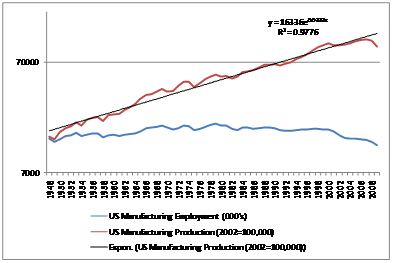
But isn't manufacturing in the United States in decline? While manufacturing employment is certainly in long-term decline, manufacturing production continued to climb right up through 2007. The recent plunge in production has brought US manufacturing back to levels last seen in 1999. Manufacturing employment, on the other hand, is back to levels last seen around the start of World War II. The difference between these two numbers is the increase in manufacturing productivity. Before the recent downturn, we were producing roughly 7.5 times what we were producing in 1948 with roughly the same amount of manufacturing workers, working out to real productivity growth of 3.3% per year.

Manufacturing production and employment:

During the same timeframe, manufacturing capacity has been growing at 3.5% per year, so capacity utilization has fallen.

Thus, when this downturn ends, the US has plenty of scope to have its manufacturing production return to its trend line, particularly in high tech equipment and other durable goods.

The key takeaways are:

Don't confuse manufacturing employment with production. Manufacturing employment since the early 1970s has been analogous to agricultural employment in the late 1800s and early 1900s, declining even while production boomed.

US durable goods manufacturing is perfectly competitive. Capital-intensive durable goods manufacturing in the US could thrive if the US government halted the currency policies that were unduly punishing it.

These are not “unprecedented” times

It is common for those in and out of the financial industry to refer to the current crisis as "unprecedented".  It may be the worst financial crisis since the Great Depression (which had two downturns, the one from 1929 to 1932 and 1937-38), although in some respects the 1980-1982 crisis exceeds the current economic downturn.  If your lens of history is the post World War II era, then yes, the current crisis is unprecedented, but of course as we learned with our assumptions that housing prices always rise, using the post war period as you only lens is a grave mistake.  As far as history goes, the current crisis rhymes with many crises in the past.  In fact, a student of historical cycles would have known this was coming, in some form, all along.

There is a long 50-70 economic cycle known as the Kondratiev Cycle.  Google it and you will find plenty of charts and books that talk about it in detail.  I'm not one to put my faith in prescice cycles as a way to time the market or predict the future with iron-clad certainty.  Nevertheless, the K-Cycle provides a good set of guidelines for understanding the larger forces as work in the economy.  You can break the K-Cycle up into "seasons":

Autumn

The last 30 years were a classic Autumn in the cycle, but with a major difference that I will explain later.  Autumn is the season of the "monetary bull".  It begins with a stagflationary peak following a war.  In the late 1970s, the inflationary spike followed the Vietnam War, and inflation and interest rates were in the double digits.  Previous stagflationary peaks were in 1920, following World War I, 1865, at the end of the Civil War, and 1820, after the War of 1812.  A conservative government gets elected that brings down inflation (which since the Civil War has meant the Republican Party).  As inflation falls, interest rates fall.  Falling interest rates results in rising asset prices.  Rising asset prices result in rising speculation and leverage.  The great bull markets in American history occur during these periods: the Era of Good Feelings (1820-1836), the Gilded Age (1865-1882), the Roaring Twenties (1920-1929), and of course the recent, yet unnamed bull market (1982-2006).  Autumn is a great time to own stocks and bonds, and sometimes, but not always, real estate.  These are the times that a great "New Economy" rises: the steam, cotton and textile economy in the Era of Good Feelings; the railroad, coal and steel economy of the Gilded Age; the mass market economy of autos, oil, appliances, and broadcasting in the Roaring Twenties; and the technology, health care and communications economy of today.  Eventually, however, interest rates fall as far as they can, asset prices rise as high as they can, and leverage increases to as high as it can, and the edifice comes crashing down.

Winter

A great financial panic then pops the bubble: the Panic of 1837 (after the Jacksonian wildcat banking and real estate boom), the Panic of 1873 (after the Greenback and railroad boom), the Great Depression (after the financial boom of the 1920s) and, apparently, the panic of 2007-2008.  During the transition between Autumn and Winter we usually have a transition from conservative to populist government.  The Jacksonians and Whigs in the 1830s and 1840s, the agrarian populists of the 1880s and 1890s, the New Dealers in the 1930s and 1940s, and the right-wing and left-wing populists that seem to dominate both parties today.  Winter is known as a "real bear", where deflation of balance sheets dominates the economy, there is a major restructuring and consolidation of businesses, the economy runs at a large "output gap" for an extended period of time.  These periods can last anyehere from 10-20 years and the best investment from start to finish is typically cash and high-quality bonds, although usually the nominal stock market bottom will occur relatively early in the Winter season, rebound strongly, and then languish, trading sideways for years.  These periods usually end with a war of some sort, which serves to reflate the economy: the Mexican War in the 1840s, the Spanish-American War in the 1890s and World War II in the 1940s.  The end of the deflationary bear market has also coincided with an increase in money supply caused by a gold strike: the California gold rush of 1849, the Klondike gold rush of the 1890s, although now that can be conjured by running the printing presses.

Spring

After Winter is Spring the "real bull".  Debt levels and prices in the private economy are low after a long period of deflation.  The overcapacity built up during the investment boom of the the Autumn has been worked off and business profitability is high.  There is a moderate, positive level of inflation that lifts profits, wages and asset prices at a reasonable pace.  Sometimes these periods are short and unsatifying, like in the 1850s, but often they are great periods for the average American: the late 1890s and 1900s and the 1950s and early 1960s.  These are also periods of rising warfare around the world.  Usually this is a period of progressive, high-minded governance.  Stocks and real estate do well during these periods and bonds to relatively poorly as inflation rises.  These periods usually end when a war and rising inflation tip the scales into Summer.

Summer

Summer is the period of the "monetary bear", where war and rising inflation lead to rising interest rates and falling asset prices.  The economy can do ok during these periods but it is masked by the terrible asset markets.  In these periods, real estate and commodities are the best investment.  The late 1850s and early 1860s, the late 1900s and 1910s and the late 1960s and 1970s were Summer seasons.  There can be some vicous bear markets during these periods: the Panic of 1857, the Panic of 1907, and the bear market of 1974.  These are usually periods of cosmopolitan governance.  Eventually, the people tire of war and/or inflation and they elect a conservative government and the cycle starts over.

What does this mean for us?

We are almost certainly in the transtion between Autumn and Winter.  We had the most outrageous Autumn in American history because we have let the dollar float.  In previous Autumn periods, the dollar was eventually re-fixed to gold at the value that prevailed before the war.  Thus inflation during the Autumn period was slightly negative as prices fell back to their levels before the war.  The dollar has since fallen from $35 per ounce to $900 per ounce.   Inflation has slowed, but stayed positive, with prices today perhaps 10 times higher than they were before the Vietnam War.  This meant that asset values could rise more than usual because the value of the currency in which they are denomiated has fallen.  The huge asset bull market, which included real estate because inflation stayed positive, meant overall leverage could rise far more than usual.  Now that interest rates can not fall any further, asset valuations can't rise any more, and debt levels, which have risen to unsustainable highs on the belief that asset prices would keep rising, can now only decline.  Only a period of dollar inflation and/or balance sheet deflation can work off the debt overhang.  It took us 30 years to create the balance sheet mess we're in, and it will likely take us 20 years to work it off.  Just ask the Japanese.

The closest historical parellel is likely the Winter period of 1880-1896, which resulted in more of a consolidation rather than a collapse.  Contrary to what some have been saying recently, there is not a strong, rising, anti-capitalist ideology like there was going into the Great Depression.  The elites of the US are generally in the pro-market camp to at least some degree, and most reform impulses are evolutionary, rather than revolutionary, in nature.  The "New Economy" will emerge as the dominant part of the economy, the "Old Economy" of manufacturing will be important but will not employ many people (much like agriculture today), and will likely be focused around hgh-value capital goods.  The new populists (like the agrarian populists of the 1880s and 1890s) will likely be (or already are) disaffected blue collar manufacturing workers from the Midwest and Piedmont, subject to swing their votes between cultural populism on the right and economic populism on the left.

Good news on the Trade Deficit

The trade deficit continues to fall.  As I outlined in Part II of my economic series, moving to a trade balance is the easiest way to at least limit the overall indebtedness of the United States.  (The more painful way is debt destruction via deflation.)

If the massive fiscal deficits coming down the pike aren't offset by equal increases in private savings and/or Fed purchases, we risk undoing some of these gains in our trade position.  The good news about Obama's spending plans are that they focus on domestic spending (health care, education, alternative energy) and not on consumer spending which has a higher marginal propensity to import.  Not that I don't think alot of those stimulus dollars will be wasted, because I do.

A combination of suppressed consumer spending (caused by suppressed consumer borrowing), a shift toward a more domestically-oriented energy mix (which should include more nuclear power if we want to be realistic about it), less borrowing from abroad and more US savings directed abroad should help dig us out of our national balance sheet hole.

Shock and Awe from the Feds

Some big announcements have been made since my last (fairly pessimistic) GDP update.

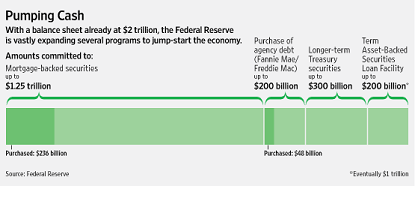
  • The Fed plans to pump $2TN into the economy.  On April 18 the Fed announced a plan to pump up to $2 trillion into the economy by buying long term treasuries, asset backed securities, mortgage backed securities and agency securities.  Interestingly, this amount corresponds to the capital shortfall I discussed in my essay on bank capital shortfalls.

  • Isn't this massively inflationary? Not necessarily. The low treasury yields (high prices), stable gold prices and relatively strong dollar imply a shortage of risk-free money and securities relative to demand. The other component of the money supply, financial system leverage to support risk capital is trying to shrink, while the demands on risk capital (supply of securities) remain high. By increasing the supply of risk-free money to reduce the demand for risk-based money, the Fed is moving toward creating more of an equilibrium in the capital markets. If you see gold rocket well north of $1,000 and the dollar break through the bottom of its long term trading range, then the inflation alarm bells can be rung.

  • Does this solve the financial problem? No. But it should cushion the deterioration in the financial markets. The Fed is providing loans, not increasing the equity capital of the banks.
  • What about Treasury's plan to buy toxic assets? I thought the best take on this was by the WSJ's Simon Nixon. Basically, there is a good chance the program won't work, because the banks' view and the private sector's view of the value of the "toxic" assets will diverge too much. Nevertheless, this will give the Fed ammunition to go to Congress for the proper amount of capital to inject into the big banks and to crush the remaining equity at places like Citigroup. If the program does work, on the other hand, we are a long way toward properly capitalizing the banks. In other words, we are moving in the right direction.
  • Who is more fiscally reckless, Obama or Bush? Many Obama supporters consistently lambasted Bush for his deficits, even though he too inherited a major crisis in the combination of the telecom/dot-com meltdown and 9-11. In both the Obama administration's and the CBO's projections, there is not a single year that Obama will produce a fiscal deficit (relative to GDP) significantly smaller than George Bush's worst deficit. I am shocked! shocked! that both parties are hypocrites when it comes to fiscal responsibility.


  • Hopefully, in the end the TARP won't really count as part of the deficit, because the funds were used to buy assets that will eventually provide a positive return to the government (here's to hoping). Sadly, the near term deficits may be necessary to allow the private sector to deleverage.
  • Will this "triple-barreled shotgun" of money revive the economy? Probably. I assume the "second derivative" of economic decline bottomed in the Q4 2008 and Q1 2009, and that growth may turn positive toward the end of the year. I am hearing anecdotal evidence of increases in car loan and mortgage applications. Housing inventories may have started to decline (at lower prices), meaning that as a percent of GDP, housing investment may have bottomed. (I do expect house prices to continue to decline, however, as the market starts clearing.) Inventories may be bottoming out now and be due for some restocking. That said, consumer spending will continue to be weak as savings rises and the job market lags the economy (as always), business investment will likely be very weak in the next couple of quarters and commercial real estate investment still has a long way to fall. The only sustainable way out of this hole is for the US to borrow demand from abroad via trade surpluses. Until that happens, we are still surfing from bubble to bubble.

2009 Outlook Part IV – The recession’s end is not near

It has taken me a while to write the final installment of my 2009 Outlook series because of all of the wild uncertainty surrounding government policy and market movements. While much uncertainty remains, it is now somewhat clearer as to which direction policy will take.

To recap, in Part I, I gave the context of how our economic policy has been guided by the experience of the Great Depression, which leads us focus on supporting demand, particularly in housing.

In Part II, I described the link between our poor currency policy, trade deficits and the buildup in national indebtedness.

In Part III, I discussed the weak capital bases of the banks and how without the banks being shored up, the stimulus will not work.

The bank bailout program is fumbling slowly in the right direction, but will be ineffective until the housing market bottoms. The housing market remains strongly overvalued and will continue to fall well into next year at least. No realistic government program can stop the decline. Given the high levels of consumer indebtedness, largely tied to real estate, we should continue to expect consumers to increase their savings rates and curtail their borrowing for a long time to come. For the world economy, reducing its reliance on US consumers is an important structural shift that needs to take place. Unfortunately, however, it is a shift the world does not seem quite ready to make. The business sector would be in decent shape to invest were it not for the problems in the banking sector. Unfortunately, the combination of collapsing consumer spending and dried up credit is causing a wave of bankruptcies throughout the business sector.

The only "savior" left is the government. The Fed is expanding the monetary base and Washington is running massive deficits. While this all seems inflationary, for the most part the government is fighting to offset the deflation in the private sector. It is not prudent to expect any sort of meaningful economic turnaround before the end of 2009. We could easily see the S&P fall to below 500 (it is at 670 now), and house prices fall another 20%. Cash and fixed income should be the investments of choice, with a small position in gold as a hedge against the possibility of a rapidly weakening dollar. Until we have reason to believe otherwise, we have to assume that the bust will return stock prices, house prices, and consumer and business indebtedness back to levels that prevailed in the early 1990s.

The Situation

The government is levering itself up in an effort to offset the decline in leverage among households and the financial sector.

Consumers
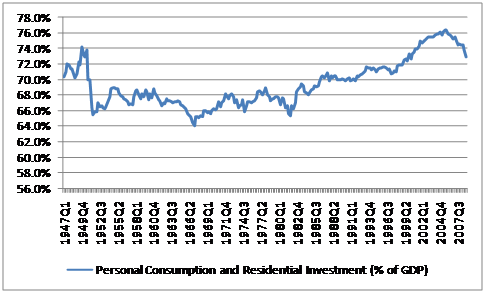

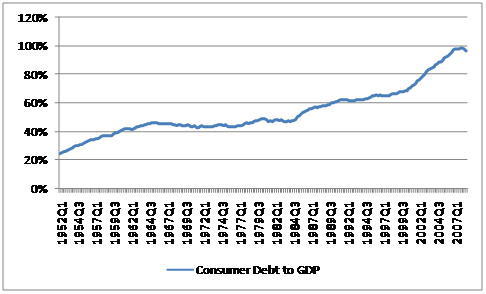
From the early 1950's to the early 1980's, personal consumption expenditures as a percent of GDP ran in the range of 62-63%. From 1982 to 2007, it climbed to 70%. Big surges came in the early 1980s and late 1990s, coincident with big stock market booms and high, disinflationary economic growth. These were also periods with a very strong and rising US dollar. Residential investment was strong in those times and in the late 1980s and mid 2000s Given the large supply/demand imbalance in housing, baby boomers needing to save for retirement, and the badly weakened financial sector, it would not be surprising to see the combination of residential investment and consumer spending to fall below the pre-1980s level of 68% of GDP in the next few years, a full 8 percentage points less than the peak level in 2005. We should also expect consumer debt to GDP to revert back to the early 1990s level of around 60%, a process that will probably take a decade or so.

Businesses

Business, on the other hand, is in reasonable shape.
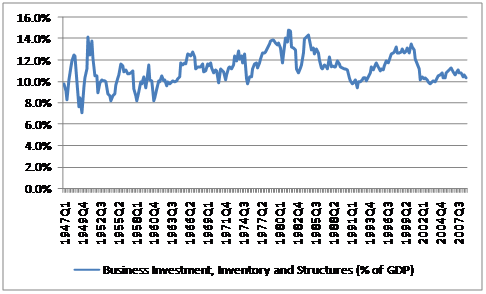
Business investment was relatively subdued this decade, following the large surge in investment in the 1990s, and profits were very high (until recently). While there was a surge in business indebtedness associated with the private equity boom, in general businesses were net savers this decade. As is typical in recessions, the next couple of years will likely see a wave of consolidation, bankruptcies and deleveraging among businesses while the financial sector contracts, after which business will be in a position to start investing again. We should probably expect business sector debt to GDP to fall from nearly 80% to under 60% over the next five years.

Interestingly, the decades with strong business investment and declining government outlays as a percent of GDP were the 1970s and 1990s, while the decades overseen by the business-friendly Republicans saw weak business investment and increased government outlays, mostly for the military. The pattern over the past four decades has been for there to be a tradeoff between business investment and defense spending on the one hand and between consumer spending and net exports on the other. Given the current upheaval in the economy and in economic policy, I'm not sure those relationships will continue to hold over the next decade.

Government

Over the next several years it is clear that, relative to GDP, government spending will rise, consumer spending will fall and business investment will be subdued.

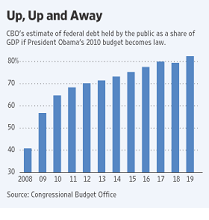
The Obama administration projects US budget deficits in excess of 10% of GDP for the next two years and around 5% of GDP for the next several years thereafter. These are massive figures unseen since World War II. It would not be surprising to see Federal debt to GDP rise to 70-80% of GDP by the end of Obama's first term. Such a rise could fully offset a decline in consumer debt to GDP back to early 1990s level of around 60% from the current 100%.

How government policy got us here

In US politics there are three schools of economic theory: Keynesians, "Supply Siders" and Monetarists. Since the Great Depression, all three schools have left their imprint on economic policy.

Fiscal policy: Keynesians vs. Supply-Siders

Booms and busts are caused by fluctuations in business investment, which get exaggerated by the expansion and contraction of the balance sheets of leveraged banks. Instead of focusing on the core of the problem, bank leverage, we have been hunting for a methodology to cure the symptoms of the problem, which are contractions in demand and debt deflation. Keynes advocated using government spending to offset periods of weak business investment, but he would have also advocated the government run surpluses when business investment was strong. Supply-siders advocated reducing taxes on investment and deregulating the business sector to encourage more business investment relative to government spending, which would increase productivity and lead to faster GDP growth. As was noted above, in the 1980s and 2000s, Republican administrations implemented a combination of Keynesian defense spending and investor-oriented tax cuts to offset weak business investment, while in the 1970s and 1990s, more liberal administrations cut defense spending and raised taxes during periods of strong business investment. In other words, the US electorate has actually successfully managed fiscal policy by changing the mix of Republicans and Democrats in Washington.

Monetary policy: the Monetarists and the dollar

Monetarists advocated increasing the money supply to offset the deflation caused by contracting bank balance sheets, and then withdrawing monetary stimulus when bank balance sheets were expanding. Contrary to popular belief, Fed Chairmen Volcker, Greenspan and Bernanke have actually practiced this fairly well. Prior to the late 1970s, however, monetary policy tended to be too loose. Since fiscal policy at the time tended to restrain business investment, the rapid money supply growth made its way into price inflation. The problem with US monetary policy has been that by focusing solely on US issues, the Fed has generally ignored the relative value of the dollar. As I outlined in Part II, periods of high real interest rates and falling nominal interest rates (like the early 1980s and late 1990s) lead to a strong US dollar, which leads to trade deficits.

The real estate money magnet

Because the government has put so much emphasis on homeownership and real estate tax incentives, the inflow of investment associated with the trade deficit has found its way into real estate lending. Add to the mix the mismanaged banking deregulations in the mid 1980s (with the S&L deregulation) and 2000s (when the GSEs and investment banks were allowed to expand their balance sheets) and the stage gets set for a banking crisis. Instead of incentivizing business investment during recessions, lower rates have encouraged consumer mortgage refinancing. The ability to manage consumer borrowing higher and higher has allowed for 25 years of economic growth, interrupted by only two brief recessions. The downside to this policy was the large buildup in US indebtedness associated with large trade deficits.

Unwinding the imbalance

The next 20 years could very well be dominated by the process of undoing this imbalance. Again, this is similar to what happened in Japan over the past 20 years after their bubble boom in the 1970s and 1980s. Japanese consumers borrowed large amount against their real estate holdings through the end of the 1980s and have since been retrenching. Real estate and stock prices in Japan have since retreated to the level of the early 1980s. The massive increase in fiscal stimulus in Japan in the 1990s (government debt to GDP rose to over 150% of GDP) and the extremely easy monetary policy of the 2000s only served to partially offset this deflation.

The US is almost certainly on the same path. Consumers' balance sheets are a mess, with crumbling asset values and high levels of debt tied to declining real estate. Consumers will now naturally focus on saving to repay debt and build up their assets for retirement, which is looming over the near-term horizon for baby boomers. Instead of giving lower-income consumers tax cuts to encourage spending, the long-term policy of the government should be focused on helping middle class consumers reduce their debt burdens and save. The United States will need to figure out a way to run trade surpluses to reduce its overall debt burden.

The operative assumption needs to be that the entire boom/bubble of the late 1990s will be wiped away. This means real estate and stock prices will go back at least to mid-1990s levels, and that the debt to GDP level will also return to those levels.

The Housing Problem

Here is an updated Case-Shiller chart of long-term real housing prices, courtesy of Barry Ritholtz. The level is currently at 158, 25-30% above the long term equilibrium. That would imply a bottom sometime in 2010-11 if prices continue down at the current pace. A return to equilibrium (or lower) is inevitable. We can slow the fall with government policy and end up with a long, slow deflation like Japan. The other way to cushion the flow is to inflate the currency, which is clearly what the Fed and Obama administration are trying to do.
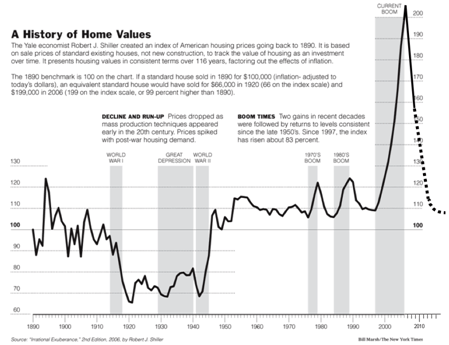
The other glaring takeaway from this chart is that if you ignore the crazy run-up from 1997 to 2006, housing is not a good investment on an inflation-adjusted basis. From 1900 to 1996, the house price index rose from 100 to 110, an increase of 0.1% per year. The only reason that housing has appeared to be a good investment is that inflation has consistently surprised to the upside relative to mortgage rates, making housing a decent inflation hedge. It can also be a decent investment in markets that have done well, like coastal California, whereas it can be a poor investment in markets that have not, like Detroit. Otherwise, as a whole, the value of the nation's real estate has basically matched inflation and little more.

So do I think Obama's plan to "stabilize" housing prices will work? I do not. The decline in house prices is a freight train that would take trillions of dollars to stop. Until the housing market bottoms, probably not until sometime in late 2010 or 2011, we will continue to have uncertainty surrounding the value of assets on bank balance sheets. While there is uncertainty on bank balance sheets, there will continue to be an underlying deflationary tug on the economy.

The Stimulus

The purpose of the just-passed stimulus is to offset some of the collapse in consumer demand and business investment caused by the banking crisis. I do not believe that there is a short-term GDP "multiplier" greater than one on this spending. Spending focused on investment, like the broadband expansion, the electronic health record investment, transportation investment, government building weatherization, school construction and the electrical grid investment, are worthwhile in that they should increase long-run productivity, encourage private co-investment and can sop up excess construction workers and industrial capacity. Besides, since the government can currently borrow at interest rates of 0-3%, you don't need a massive ROI to justify the investment.

I would have preferred to see the aid to the states structured as loans that could be called in when economic growth returns. State and local governments have structured their budgets during the unsustainable boom times of the past 25 years and they should not be encouraged to maintain those levels of spending. Particularly egregious are the retirement benefits that have been promised to public sector workers. Expect revolts across the country as taxpayers rise up to rein in these benefits.

The Bank Rescue

As I outlined in my outlook Part III, I think the banking sector needs a lot more money to stay solvent. The Obama administration is on the right track with their stress tests and the $750 million contingency it has placed in its budget. The question is whether Congress will go along. I expect Obama will follow up with an overhaul of banking regulations that will focus on restraining balance sheet leverage. (The BIS standards are also moving in this direction.) I also expect there to be a great deal of political pressure for the US to re-privatize its bank investments within the next five years. These two factors will restrain both lending, as banks build up their capital bases, and money supply growth as TARP money flows back into the Treasury. It's the right thing to do, but will restrain economic growth.

The Obama budget

Without getting in to the merits of basic Democratic policies over Republican ones, I will focus on the items that will directly affect economic growth. Taxing high incomes more and providing rebates to lower income workers will marginally stimulate consumer spending at the expense of saving. On the other hand, the cap-and-trade carbon tax system will function as a consumption tax. Raising the tax rate on capital gains and dividends from 15% to 20% will make stocks marginally less attractive than bonds. The idea of the universal savings accounts, automatic 401k enrollment and government matching funds is a sound one and should help middle class families save more. The phase out of the mortgage interest deduction for high income earners should start to reduce the emphasis on housing investment and associated consumption by high earners.

The increase in consumption-related taxes and the idea of the universal savings accounts are pushing us in the right direction. The increased taxes on investors and small businesses are counter-productive, but Obama might get away with it because business investment is poised for a comeback next decade anyway. When the financial crisis eases, probably by early-mid 2010, there could be a brief surge in economic growth due to inventory restocking and pent-up investment demand. By 2011, however, it is currently projected that fiscal stimulus will ease, with the higher tax rates kicking in and the withdrawing of TARP funds from the banks.

The focus on education and health care are good for long term economic growth, but in the end the US already spends more per capita in these areas than other developed nations. The key in both of these areas will be on improving efficiency (aka productivity). Figuring out how to bring down the cost of health care would be a great boon to small businesses. The focus on energy and transportation could go a long way toward improving the US's terms of trade, but the focus on renewables at the exclusion of nuclear power is disingenuous at best. The most bang for the buck actually comes from increasing energy efficiency more than from alternative sources of energy.

As I described in this earlier post, it is now clear that Obama's budget blueprint is also a missile straight at the heart of the old Republican power structure. Health insurance companies, drug companies, student lenders, defense contractors, oil and gas companies, mining companies and large agribusinesses all stand to lose a great deal if Obama's budget passes in its current form.

At some point in the next several years we will need to figure out how to restrain the growth of Social Security and Medicare. It will become clear that economic growth will not be sufficient to produce an easy fix, and we will likely see a pretty major restructuring of these two programs, probably with an increase in the retirement age and reduced benefits for the wealthy.

As remote as it may seem right now, the big problem the US faces over the next two decades will be a shortage of labor. Economic growth (and supporting retirees) will depend on making each worker more productive. That means a policy mix focused on business investment, infrastructure investment, continuing education and health care. Overall, it seems that the Obama administration understands this, but is bogged down by some of the traditional anti-business Democratic Party policies.

Conclusion

While the second derivative of the economic decline is probably bottoming in this quarter or the next, we should expect economic growth in 2009 to remain negative throughout. Corporate profits in 2009 will be terrible. While my math puts the fair value of the S&P 500 in the range of 600, we could easily see a bottom in the 400-500 range if past bear markets are any guide.

By early-mid 2010, with housing prices nearing a bottom, the kicking in of the stimulus, a repair of bank balance sheets and inventory restocking, we might see a couple of quarters of decent growth. The problem will be that without strong global growth and a period of US trade surpluses, the growth will not be sustainable. Add to this the restrained growth of bank balance sheets and the specter of higher taxes, it will be difficult to maintain the rebound in growth. We could easily see a return to recession in 2011-2012.

Deflation will be the dominant economic impulse. While it seems like all of the money printing and the huge deficits should be inflationary, for the most part it will be offset by declines in indebtedness in the private economy. Until stocks are preposterously cheap, fixed income and cash should be the investments of choice. I'm not sure what the mix of a massive inflation in the monetary base and private market deflation mean for the price of gold. It is probably worth maintaining a position in gold as a hedge.

In the intermediate term, businesses should be poised for a strong investment cycle. We could therefore see a return to organic GDP growth by the middle of next decade. In any event, the US will not be able to sustain long-term GDP growth without a restructuring of world demand to support a long period of US trade surpluses and US debt reduction.

The scenario above is my base case. I will update it as circumstances change, as they almost certainly will.

Progress on Financial Rescue

In Part III of my 2009 economic outlook series, I made the argument that government would need to inject another $1-1.2 trillion into the banking system to stabilize the economy.  The Wall Street Journal reported today that the Obama administration is considering doing just that.  [subscription required]  Supposedly the plan could be announced in the next couple of days.  This should be viewed as constructive for the markets.  In my view, this makes a massive fiscal stimulus package unnecessary and potentially inflationary and dollar-negative.  While I like the investment focus of much of the package as a blueprint for future government spending focus (transportation infrastructure, energy efficiency, electrical grid, broadband access, electronic medical records), and have no problem with running mild deficits, the magnitude of the deficits we run will be the greatest by far relative to the economy since World War II and serves to put us further in debt to foreign countries when we should be seeking to move in the opposite direction. 

[Chart]

Source: WSJ.  Note: this chart doesn't include potential $1-2 trillion of additional bank capital injections

I don't mind the portion of the deficit allocated to the bank recapitalization, as long as the money is used to buy assets that will be sold eventually while providing a positive return.

2009 Outlook Part III – Shrink the stimulus, triple the TARP

In Part I of my 2009 Outlook series, I wrote about how the US's current economic policy framework is driven by a reaction to the Great Depression, when the old policy framework that favored producers, lenders and exporters collapsed into deflation and shrinking world trade. The policy mix since that time has been designed to favor consumers, borrowers and importers and has been embraced by both parties in different ways. The result has been a promotion of consumption at the expense of savings, a build-up in US indebtedness, and chronic trade deficits. In Part II, I discussed the link between a rising dollar and trade deficits, between trade deficits and a rise in overall indebtedness, and between dollar decline and foreign currency manipulation.

Ideally, an economic policy mix would balance the needs of consumers and producers, importers and exporters, lenders and borrowers. Unfortunately, that is not how politics work. People build up their biases over their lifetimes and they don't let them go easily. Also, we have a peculiar political situation in the US currently, in that the GOP has a traditional policy platform that favors producers and lenders, but those economic policies tend to favor the "blue states" in the north and west coast. The Democratic Party traditionally promotes the interests of borrowers and consumers, but those policies actually favor the economic interests of the "red states" in the South, Rockies and Great Plains. The only economic policy that has retained its traditional regionalism is trade, with the south favoring free trade more than the north. This policy confusion stems from the parties' gradually switching regions from the late 1960s to 2000, when the Red State-Blue State realignment was completed under George W Bush.

In my first two sections I focused on what should be done to fix the economy, which would be to stimulate foreign demand at the expense of US consumption, stabilize currency values, and take action to prevent US trade deficits, even running temporary trade surpluses to reduce our net debt. Of course it's actually more important to know what actually will happen. The people in charge of our economic policy…politicians, fed officials, treasury officials…have all been taught to fight deflation and support demand at all costs. That means large increases in the supply of money and talk of massive fiscal stimulus. These things ARE going to happen, so the important question at this point is whether the programs will work.

After much deliberation, I have come to the conclusion that the government "bailout" of the financial industry is vital and too small, and that the proposed financial stimulus program is unnecessary and potentially counterproductive.

Economic crises are always banking crises

Since the dawn of capitalism, every broad-based economic downturn has been caused by the same thing: contraction of banks' balance sheets. Banks are inherently unstable institutions because they are highly leveraged. They make loans, which are bank assets. They can post these assets as collateral to borrow from each other essentially ad infinitum, so that their assets can far exceed their equity capital. When times are good, banks get overextended by borrowing too much relative to their equity capital and by making overly risky loans. The economist Hyman Minsky described the process of the banking boom-bust cycle as moving from hedge finance (cash flows cover interest and principal payments) to speculative finance (cash flows cover interest but not principal) to ponzi finance (cash flows cover neither interest nor principal, and loans can be repaid only by selling the asset at a higher price). The migration to ponzi finance was evident in the recent real estate and LBO bubble. When the bubble of ponzi finance pops, the cycle runs in reverse from ponzi to speculative to hedge finance. The reverse cycle means valuations (price relative to cash flow) need to fall until the yield is able to service both principal and interest payments.

The boom-bust cycle would be limited to the primary area of speculation and would not affect the broader economy if it were not for the highly-leveraged nature of banks. If a bank has equity capital equal to 10% of its assets, it could withstand losses equal to 10% of its assets before its liabilities exceed its assets and it becomes insolvent. Of course it's actually worse than that. If a bank started with a capital ratio of 10% and the value of its assets fell 8%, it would have a capital ratio of 2% and for all means and purposes be insolvent anyway, because depositors would remove their money from a bank with such a small capital base. Undercapitalized banks feel the need to sell assets to raise cash and meet depositors' demands, which of course depresses asset values even further and causes more forced selling. Back before the Depression, this would cause banks to collapse, which would wipe out customers' deposits. The vanishing deposit accounts amount to a contraction of the overall money supply, which leads to price deflation. The New Deal financial reforms were designed to prevent deflation by breaking banks up into smaller, more specialized entities that would trade high levels of regulation for the benefit of being able to maintain relatively high leverage.

The above chart from the Economist is forecasting that new regulations will force commercial banks to return to pre-Depression era levels of capitalization. For this to happen, however, either banks' assets would have to decline by 33% relative to the same equity base, or bank's equity would need to increase by 50% relative to the same asset base, or some combination of the two. That would be difficult enough if it was not for another large wrinkle.

The decline of the "shadow banking system"

As commercial banks tottered through crises in the 1980s (Latin American lending, the S&L crisis, the LBO bust), a new, parallel financial system arose that has been dubbed the "shadow banking system". Financial innovations like the money market mutual fund, commercial paper, asset backed securities, structured investment vehicles, derivatives, credit default swaps, collateralized debt obligations, credit hedge funds, and prime brokerage services allowed for the creation of a huge lending function performed by the securities markets and off the balance sheets of traditional commercial banks.

The changing mix can also been seen in this chart I once found (apologies to the authors…I can't remember where) that shows the balance sheets of various sectors of the financial system prior to the financial meltdown.

Here it's clear that the financial intermediaries in the shadow banking system (brokers, hedge funds, GSEs like Fannie Mae and Freddie Mac) are the ones that behaved particularly irresponsibly. At 30:1 leverage, if your assets fall only 3% in value, you are wiped out…which is exactly what happened. Since that time, the federal government has seized the GSEs and the commercial banks have absorbed the balance sheets of the brokers. In addition, the commercial banks have added around $500 billion in loans as commercial paper back up lines were called in and the entire structured investment vehicle universe was shut down. That means commercial banks, before the effect of write-downs in the financial crisis, would have had assets of $16,690 billion, liabilities of $15,419 billion and equity capital of $1,271 billion, or leverage of about 13.1 times equity or a capital ratio of 7.6%. If we include savings institutions and credit unions on the banking sector balance sheet, we arrive at assets of $19,352 billion, liabilities of $17,765 billion and equity capital of $1,587 billion, or a capital ratio of 8.2%.

Economist Nouriel Roubini of RGE Monitor (www.rgemonitor.com) has estimated that US banking losses and write-downs in the crisis are likely equal to $1,800 billion. (For the record, Mr. Roubini has been one of the most prescient observers of the financial bubble and subsequent meltdown.) That means assets contract to $17,552 billion, liabilities remain at $17,765 billion, and equity capital becomes negative $213 billion. Just to return the banking system to adequate capitalization of 10%, the banking system needs nearly $2 trillion of total equity injections. So far, there has been $350 billion from the TARP, another $100 billion or so in private and sovereign wealth fund capital and another $350 billion in TARP II funds just approved by Congress (as long as it isn't wasted on trying to prop up housing prices). Maybe there has been another $100 billion in offsetting retained operating profits (I'm being real rough here, I don't know the data). Basically, the banking system of the United States needs another $1-1.2 trillion of capital injections, probably from the federal government, just to be adequately capitalized.

Shrink the stimulus, triple the TARP

Until banking system is adequately capitalized, no matter how much you spend on fiscal stimulus the gears of the economy won't catch (in a forward direction at least). Japan is a conspicuous example of this problem. Japan spent trillions on "infrastructure" spending in the 1990s, running their national debt to over 100% of GDP, with no natural economic expansion to show for it. While Japan's borrowing and spending on infrastructure was better than doing nothing, the country has been mired in a soft deflationary depression for the past two decades. Japan's "zombie" banks and corporations were propped up just enough to slowly work their way out of insolvency, but not enough to expand lending and borrowing. Now asset values in Japan are back to levels not seen since the early 1980s. In the United States, that would be the equivalent of retreating to the values of the early 1990s…think Dow 2,500 and S&P 300.

Besides, the problem in the US has not been a lack of demand, it has been an excess of demand driven by relentless expansion of the financial sector, prolific consumer spending and, at times, prolific government spending. Rather than try to prop up domestic demand at unsustainable levels, the government should instead focus on easing the effect of a decline in consumer spending by figuring out ways to shift the mix of demand to more domestic sources of production. Many of the items in the proposed stimulus package are worthwhile in this regard, and should be part of the long term government spending program. They just won't really stimulate the economy in 2009. If the money is borrowed from abroad, the offsetting capital account surplus will directly cause a current account deficit and be subtracted from 2009 GDP growth. If it is paid for by the Fed's printing money, then it is pure inflation. (I'll leave the rest of my discussion of fiscal policy to Part IV.)

The good thing about the TARP is that it is buying assets that can be monetized at a later date. The US government gets to borrow at 0-3% and purchase preferred stock that pays 5-10%. The banks, after they return to health, can buy back the preferred stock or it can otherwise be sold into the open market. In my view, the government should issue straight preferred with a dividend rate at the high end of that range. This would encourage the banks to repay the preferred stock as quickly as possible, without giving the current common stockholders a super-sweetheart deal when they actually deserve to be wiped out. Because the preferred stock will be repaid, with dividends, it gives the federal government a way to stimulate the economy without adding to the future debt of the United States or further debasing the currency. It would not, however, be great for existing bank common stock holders.

In addition to this capital overhang, I expect the Obama administration and the current Congress to clamp down on the financial system with a new regulatory regime. My assumption is that the regulatory regime will focus on systemic risk and managing bank capital ratios in a counter-cyclical fashion. It will also reign in hedge funds and risk-taking by banks. The golden era of finance in the US will be over, not to return for at least two generations.

The secular decline of finance

One consistent trend in the US economy since World War II has been the rise of finance. While the financial sector got beaten up pretty hard by the Roosevelt Administration in the 1930s and 1940s, it has climbed relentlessly since then. Financial debt to GDP has risen from 3% of GDP in 1952 to nearly 120% of GDP in 2008. The finance sector expanded its balance sheet faster than trend in the late 1970s, early-to-mid 1980s and late 1990s, all of which were major periods of innovation and expansion. While there have been many benefits to the rise of finance, it has also distorted the economy. The US government has practiced an asymmetric "socialism for the rich" with its policies of letting booms run and then fighting downturns by printing money to protect investors. In history, when nations over-luxuriate in the riches of high finance, they experience inflation, deteriorating terms of trade, a decline in the productive economy and high income inequality. It is not dissimilar to the effect of oil wealth.


I work in finance, but nevertheless feel that the US would benefit from a shrinking of the finance sector relative to GDP. I expect the new financial regulatory regime to effectively turn the banking system into a conservative oligopoly, which will dampen both asset and price inflation. This in turn will direct capital away from speculative uses like trading derivatives and gambling on real estate inflation. Capital will instead flow toward investment projects with more of a demonstrable cash-on-cash return on investment.

What does this mean for 2009?

I don't think that there is any way out of the general debt deflation until the banking sector is recapitalized with an additional $1-1.2 trillion. There may be some initial euphoria surrounding the stimulus plan, but it will likely be short-lived. There is no way to avoid a continued 15-30% decline in house prices in 2009, outside of hyperinflation. The auto sector needs to shed 20% of its capacity to be remotely viable. There will continue to be liquidations of retailers and large amounts of commercial real estate bankruptcies. The media and consumer internet sectors are saddled with overcapacity as well. The inventory-to-sales ratio has spiked, which will lead to continued discounting throughout the economy. Consumers will continue to increase their savings rates and pay down debts (as they should, economists be damned).

Until I see the TARP increased by $1 trillion, I will maintain a cautious stance, heavily overweighting short term treasuries, investment grade bonds and gold.

Next: Part IV – The recession's end is not near